

Workplace mental health obligations are becoming increasingly important, with employers facing growing legal, regulatory, and organizational responsibilities around psychological health and safety. Regulators are watching more closely, employees are asking sharper questions, and lawsuits tied to psychological harm are climbing year over year. Every employer, regardless of size, now needs a clear plan for handling this.
This guide breaks down what it actually means in practice today, walking through the laws behind it, the risks of getting it wrong, and the concrete steps that protect both your people and your business along the way.
The topic used to live comfortably in the HR “nice to have” folder, tucked somewhere near wellness newsletters and step-count challenges. Not anymore. Boards now ask about psychosocial risk in the same breath as cybersecurity and financial controls, insurers probe it during underwriting, and job candidates bring it up unprompted in interviews. The pressure is converging from every direction at once, and it isn’t slowing down.
That shift matters in a very practical sense. It means compliance teams, HR leaders, and line managers all need to be working from the same understanding of the rules, rather than improvising as issues arise. It also means that policies written five years ago, however well-intentioned at the time, may already be quietly out of date.
What Is Workplace Mental Health Compliance?
At its core, it means meeting your legal duties around employee mental health while also building systems that support genuine wellbeing rather than producing paperwork for its own sake. The two goals reinforce each other when done well, and pull apart painfully when one is treated as a checkbox.
In the US
Employers have to navigate the Americans with Disabilities Act (ADA) alongside the Mental Health Parity and Addiction Equity Act, and the two laws ask for different things. The ADA requires reasonable accommodations for conditions like depression, anxiety, or PTSD, as long as the accommodation doesn’t create undue hardship for the business, and it simultaneously bans discrimination based on mental health status while requiring strict confidentiality for any disclosed medical information. Parity law adds another layer on top of that, since mental health and substance use benefits cannot face tougher restrictions than medical or surgical benefits would, whether that shows up in copays, deductibles, or prior authorization rules.
In the UK
The picture looks similar even though the legal language differs. Under the Equality Act 2010, certain mental health conditions count as a disability, and this applies whenever the condition has a substantial, long-term impact on daily life and is expected to last at least 12 months. Depression, anxiety disorders, PTSD, and bipolar disorder frequently meet that threshold, which pulls a large share of everyday workplace struggles directly into legal territory.
The EU and Australia
These locations take a somewhat different angle, but they arrive at a similar destination. Many EU member states now reference psychosocial risk standards directly within occupational health and safety law, treating mental strain the same way they’d treat a physical hazard. Australia’s Work Health and Safety framework goes further still, requiring employers to manage psychological hazards with the same rigor as physical ones, and regulators there have already issued specific codes of practice on psychosocial risks while ramping up enforcement.
In line with the above, ISO 45003 has quietly become a useful reference point across all four regions, even though it’s a voluntary international standard for managing psychological health and safety at work and compliance with it isn’t legally required anywhere yet. ISO 45003 has also become a useful reference point for organizations seeking to manage psychological health and safety at work. While it remains a voluntary international standard rather than a legal requirement, its framework can help organizations systematically identify and manage psychosocial risks.
Taken together, these developments show that employers across many jurisdictions are facing increasing legal and regulatory responsibilities related to employee mental health, psychological safety, and psychosocial risk. The exact obligations vary by country and applicable law, making jurisdiction-specific compliance essential. Regulators in all four regions are actively enforcing duties to assess and manage psychosocial risks, and the era of treating this as discretionary is closing.
Why Workplace Mental Health Compliance Matters Now
Tribunal cases increasingly involve depression, anxiety, and work-related stress. A routine wellbeing conversation can quickly become a legal matter when employers fail to follow the correct procedures, particularly when absence and important timelines enter the picture.
Psychological injury claims can create additional exposure through workers’ compensation. Insurers increasingly offer risk services that combine workplace assessments, manager training, and policy support, helping organizations demonstrate a proactive approach to prevention.
Poor mental health practices can also create significant financial costs. Claims, tribunals, and turnover often cost more than preventive measures, while replacing employees affected by burnout adds recruitment, onboarding, and lost productivity costs. Stress-related absence and presenteeism can further reduce productivity and affect work quality.
Reputational risks add another layer. Employer review sites and social media make workplace culture increasingly visible, and a poorly handled accommodation request can damage an organization’s reputation and recruitment efforts.
Core Pillars of Workplace Mental Health Compliance
Strong mental health compliance tends to rest on a handful of core pillars, and each one closes a different gap that the others can’t quite cover on their own.
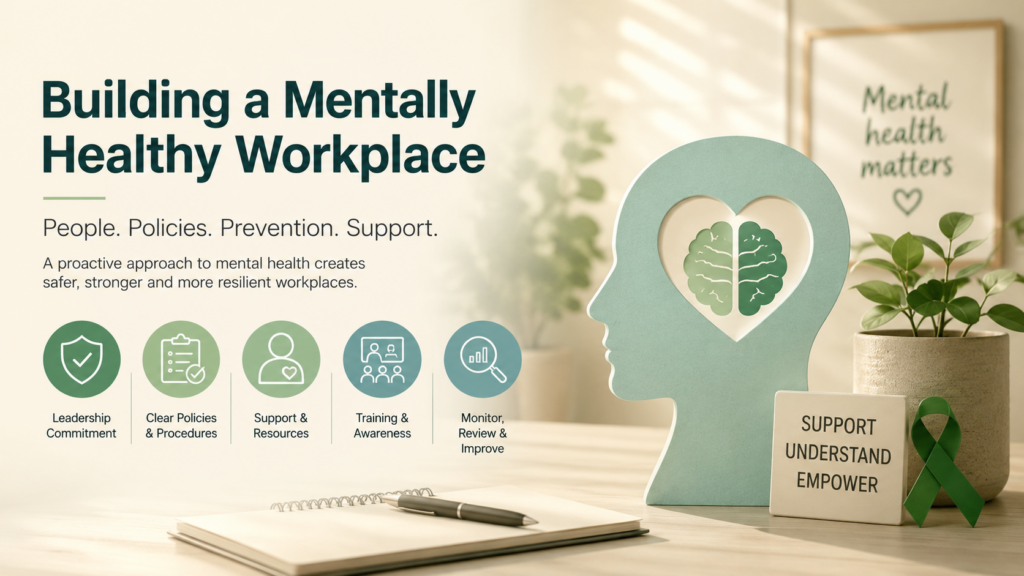
Clear Policy
Every organization needs a written policy, and a strong mental health policy framework addresses systemic factors rather than just individual lifestyle choices, setting clear boundaries around what the organization actually commits to providing. Policies also need to be living documents rather than static ones. Treat stress risk assessments as ongoing tools rather than one-off paperwork. Review them whenever your organization experiences changes, such as restructuring, rising workloads, shifting absence trends, or a serious incident. Many teams settle on an annual review as a practical minimum.
Manager Training
It’s arguably the highest-leverage piece of the whole puzzle. Managers are usually the first to notice when something’s off, yet most haven’t been given the tools to respond well. WHO guidance strongly recommends manager training as an important component of a comprehensive approach to workplace mental health. That said, training has real limits. Managers need enough information to provide appropriate accommodations and maintain a safe workplace. However, they should not receive detailed diagnoses or treatment information. Organizations can protect everyone involved by establishing clear protocols that define who can access specific information and what they need to know.
Documentation
This area matters more than most people expect because written records provide evidence that memory cannot always preserve. In disputed mental health cases, employers often face the same issue: they cannot show what they discussed, agreed to, or offered because they did not document the conversation. Good documentation does not need to be elaborate. After each check-in, managers or HR teams can record the date, key points discussed, and any agreed next steps. The goal is not simply to create a paper trail, but to turn good intentions into consistent, demonstrable action when questions later arise.
Reasonable Accommodations
They are another important component of compliance. In jurisdictions such as the United States, employers may have accommodation obligations when an employee has a qualifying disability, even where the employee’s condition is not necessarily permanent or outwardly visible. The specific requirements depend on the applicable law and circumstances. An employee qualifies for accommodation if an untreated condition would substantially limit a major life activity, whether that’s concentrating, sleeping, or communicating, and the condition itself doesn’t need to be permanent or severe for that to apply. Employers, for their part, need to act in good faith throughout: an employer cannot fire, demote, or refuse to hire someone simply because of a mental health condition, or because they asked for an accommodation in the first place.
Data Privacy and Confidentiality
These deserve their own spotlight, since mental health information ranks among the most sensitive data an employer will ever handle. Medical documentation should never sit in a general personnel file; it belongs in a separate, restricted record, with access limited strictly to people who genuinely need it to do their jobs. Clear protocols help draw that line. A supervisor might need to know an employee requires a flexible schedule, for instance, without ever needing to know the underlying diagnosis behind it, since HR or occupational health can hold that detail instead and share only what’s relevant to the accommodation itself. This separation protects trust as much as it protects compliance, and employees who believe their disclosures will stay confidential are far more likely to come forward early, before a problem escalates into something harder to manage.
Building Workplace Wellbeing Into Daily Operations
Compliance sets the floor here, but workplace wellbeing is what raises the ceiling above it.
Real workplace wellbeing tends to come from how work itself gets designed, not just from which benefits get listed in an offer letter. Workload, autonomy, and management style all shape employee mental health outcomes daily, often more than any formal program does.
Small shifts in manager behavior can make a surprisingly measurable difference here. A manager who asks “How can we adjust your workflow to better support your focus?” signals something quite different than one who simply waits for a formal complaint to land on their desk. That kind of proactive check-in normalizes support before a situation turns urgent, and it has the added benefit of creating a documented trail that protects everyone involved if questions come up later.
Psychological safety underpins all of it, ultimately. Teams that feel safe raising concerns tend to catch problems early, while teams that don’t tend to hide struggles until they surface as resignations, errors, or formal grievances instead. Organizations cannot build psychological safety through a single training session. Leaders and managers must reinforce it consistently through every one-to-one conversation, team meeting, and performance review.
An employee assistance program is one genuinely useful tool in this mix. It gives staff confidential access to counseling, referrals, and short-term support, though it won’t, on its own, fix systemic problems like chronic overwork or poor management. That’s exactly why corporate wellness programs need to go further than a single offering. The strongest ones combine an EAP with workload reviews, psychosocial risk assessments, and manager coaching, working together rather than in isolation, while programs that focus only on apps or one-off webinars tend to rarely move the needle in any lasting way.
Steps Toward Workplace Mental Health Compliance
Pulling all of this into a workable roadmap, a few steps tend to come up again and again. Start by auditing current policies against the ADA, parity law, and whatever local equivalents apply in your jurisdictions, since gaps tend to hide in the details rather than the headlines. From there, train managers on recognition, referral, and the privacy boundaries that keep them out of clinical territory they shouldn’t enter. Strengthen your employee assistance program and make sure people actually know it exists, since an underused benefit helps no one. Document every accommodation conversation and decision as you go, rather than reconstructing the timeline after the fact. Review psychosocial risks at least once a year, more often for higher-risk teams. And throughout all of it, track outcomes rather than activity: psychosocial risk scores, stress-related absence, and willingness to disclose tell you far more than a simple count of training sessions run.
Conclusion
Workplace mental health compliance protects employees and employers alike, and the case for taking it seriously keeps getting stronger. The laws are clear, enforcement keeps growing, and the data on cost versus benefit is becoming hard to argue with.
WHO estimates that every $1 invested in scaling up treatment for depression and anxiety can generate approximately $4 in improved health and ability to work.
Get the policy right, train your managers well, support your employee assistance program properly, and build corporate wellness programs that address real causes rather than just symptoms. Do that, and workplace mental health compliance stops being a liability to manage and starts becoming a genuine strength instead.
What are you waiting for? Start Now.
Start Building A Stronger Workplace TodayFrequently Asked Questions
Managers should generally focus conversations on work performance, workload, observable concerns, and available support rather than attempting to diagnose or investigate an employee’s mental health. However, the rules governing medical or disability-related questions vary by jurisdiction and employment circumstances.
At least once a year, as a practical minimum, though higher-risk teams or teams going through major change often warrant reviews more frequently than that.
No, it remains voluntary, but it’s quickly becoming the de facto benchmark – regulators reach for it when judging whether an employer acted reasonably.