

Employee wellbeing legal requirements vary by jurisdiction, industry, and workplace, but employers cannot ignore the legal duties that apply to them. Failing to meet those responsibilities can quickly increase legal, financial, and operational risks.
Many employers treat this area as background noise, assuming a safety manual written years ago still covers them. It usually doesn’t. Standards shift, enforcement priorities change, and a policy built for a different era can quietly leave real gaps in place today.
The stakes go well beyond fines, too. A missed requirement can mean an injured worker, a damaged reputation, or a costly lawsuit, and getting this right protects people first and the business second, in that order.
This guide breaks down what employers actually need to do, walking through the rules, the gaps that trip people up, and the practical steps that keep an organization genuinely compliant rather than just looking compliant on paper.
What Are Employee Wellbeing Legal Requirements?
Employee wellbeing legal requirements cover more than physical safety alone. They include mental health, fair treatment, and basic working conditions, and employers can’t pick and choose which parts apply to them.
In the US, the foundation is the Occupational Safety and Health Act of 1970, which created national workplace safety standards enforced by OSHA. Employers must provide a workplace free from serious recognized hazards – aligned with the standards, rules, and regulations issued under the Act.
Employers must also examine workplace conditions regularly, checking that conditions conform to applicable OSHA standards. This isn’t a one-time task to complete and forget. It’s ongoing, by design.
Federal rules set the floor, and states can add more on top of it. OSHA sets national standards, but individual states may layer on stricter requirements, often shaped by local industries and regional hazards, which means employers have to track both levels at once.
This dual structure trips up a lot of businesses. A company operating across five states might face five slightly different rule sets, and what satisfies federal law in one location may fall short in another. Multi-site employers need a real system for tracking these differences, rather than applying a single generic policy everywhere and hoping it holds up.
Public sector rules add another wrinkle on top of all this. Federal agency heads carry their own responsibility for safety under a separate section of the law, even though OSHA doesn’t issue fines to them directly, and mining, nuclear energy, and parts of the transportation industry fall under different federal agencies entirely. Knowing exactly which rules apply to your specific operation is the first real step toward genuine compliance.
What Employers Must Actually Do
Employer legal responsibilities start with hazard identification, and employers need to be well-versed in their legal duty to protect employees, since the OSH Act entrusts them with providing a safe and healthy workplace from the outset.
Risk Assessments Sit At The Center Of This Duty
Carrying out risk assessments is a pivotal part of effective health and safety management, starting with identifying the hazards employees are most likely to encounter, and skipping this step weakens everything that follows.
Training Matters Just As Much
Employers must give workers the tools to stay safe, and where engineering controls can’t be feasibly implemented, employers must ensure employees are trained on, and actually use, personal protective equipment.
Posting Information Is Also Required By Law
Employers must prominently display the official OSHA “It’s the Law” poster describing rights and responsibilities, so employees always know where they stand.
Reporting Serious Incidents Is Non-Negotiable, Too
Employers must notify the relevant authority when an employee is killed on the job or suffers a hospitalization, amputation, or loss of an eye, and delays or omissions here carry real penalties.
Employer Legal Responsibilities Don’t Stop At Compliance Paperwork
They extend into culture, training, and follow-through, since a policy on paper means little without action behind it.
Consider how this plays out in practice. A company might have a beautifully written safety manual sitting in a shared drive, but if no one’s been trained on it, if hazards haven’t been inspected in months, and if incidents go unreported, that manual becomes worthless the moment a dispute arises. Regulators and courts look at what actually happened on the floor, not what’s written in a binder somewhere.
Small businesses sometimes assume these duties don’t apply to them, but they do. Size affects which specific standards apply, and smaller employers may qualify for consultation programs, yet the underlying duty to provide a safe workplace doesn’t shrink along with headcount.
Where Mental Health Fits Into the Law
Employee well-being used to mean physical safety alone. That’s changed, and mental health now sits squarely inside the same legal conversation.
- In many jurisdictions, regulators increasingly recognize psychosocial risks as an important workplace health and safety concern. Stress, excessive workload, and other working conditions that affect psychological health can create legal and organizational risks when employers fail to address them appropriately.
- Workplace wellbeing extends beyond formal policies. Workload, scheduling, and management practices can all affect employee health, and employers should consider how applicable workplace health, safety, employment, and anti-discrimination laws apply to these conditions.
- Courts and regulators may consider patterns of workplace concerns alongside individual incidents. Repeated complaints or warning signs that an employer fails to address can create greater legal and organizational risk than an isolated issue handled promptly and appropriately.
This pattern-based thinking matters for how employers respond to early warning signs. A single complaint about excessive workload might seem minor in isolation, but several complaints from different employees, spread across several months with no documented response, tell a very different story if a regulator or court ever reviews the file. Early, documented responses to small concerns often prevent much larger claims later on.
Mental health protections can also intersect with anti-discrimination and disability laws. Depending on the jurisdiction and the circumstances, a mental health condition such as anxiety or depression may create accommodation or other legal obligations for an employer.
The Legal Floor for Safety
Occupational health and safety law sets the minimum standard, not the ceiling, and smart employers treat it as a starting point rather than a finish line to cross and forget.
OSHA enforcement varies by state, since some states run their own OSHA-approved plans that often go further than federal rules. Employers operating across state lines need to track every variation carefully, rather than assuming uniformity where none exists.
Occupational health and safety also covers reporting and consultation, and free consultation services exist specifically for smaller businesses. These services help address safety hazards, improve safety programs, and train employees, sometimes even offering a one-year exemption from routine inspections, though many employers simply don’t know this option exists.
Whistleblower protections fall under the same broad umbrella. OSHA administers whistleblower laws tied to safety and health, protecting workers who report violations, and retaliation against a reporting employee creates serious legal exposure for the employer involved.
These protections exist for good reason. Workers who fear retaliation often stay silent about hazards until something goes wrong, while a culture that genuinely protects reporting employees tends to catch problems earlier, before they escalate into injuries or formal complaints. Employers who punish reporting, even subtly through reduced hours or sidelined assignments, expose themselves to claims that can end up far costlier than simply fixing the original hazard would have been.
Turning Workplace Health Compliance Into Daily Practice
Strong workplace health compliance starts with documentation, since every inspection, every training session, and every incident report needs a paper trail behind it. Memory fades quickly. Records don’t.
Staying current matters just as much as documenting well, and workplace health compliance only holds up when it keeps pace with changing rules. Rules change, standards update, and an employer who reviews policy once and then forgets about it tends to fall behind faster than expected.
Audits help close the gaps that inevitably open up over time. Run them regularly, compare current practice against current law, and fix what’s outdated before a regulator finds it first.
Training records matter just as much as the training itself. If a worker was never properly trained, no policy document will help much in a dispute, so proof of training ends up protecting everyone involved.
Technology has made this considerably easier than it used to be. Digital training logs, automated reminders for refresher courses, and centralized incident reporting all reduce the chance that something slips through unnoticed. Employers still relying on paper logs and verbal sign-offs are taking on risk that’s largely avoidable today, given how far the tools have come.
It also helps enormously to assign clear ownership over this work. Someone in the organization needs to own it full time, even at smaller companies where it ends up layered onto another job as a part-time responsibility. Diffuse responsibility, where everyone assumes someone else is tracking compliance, is one of the most common reasons gaps go unnoticed until an inspection or incident forces the issue into the open.
Wellness Perks: Useful, But Not a Shield
Employee wellness programs genuinely help, but they don’t replace legal compliance, and that distinction trips up far more employers than it should.
A strong employee wellness program might include counseling access, fitness perks, or flexible scheduling, and these benefits boost morale in real ways. They simply don’t satisfy hazard-specific legal duties on their own, no matter how well-intentioned they are.
Employee wellness programs work best when layered onto real compliance rather than offered as a substitute for it. Pair wellness perks with documented risk assessments, pair them with proper training records, and together they build a genuinely defensible position rather than a superficial one.
Some employers lean on wellness programs and skip the harder compliance work entirely. That’s a mistake, since regulators don’t accept a yoga class as a substitute for actual hazard controls.
This gap tends to show up most clearly after an incident occurs. An employer points to a robust wellness offering as evidence of care, only to discover the underlying hazard assessment was never completed in the first place. Wellness perks and hazard controls answer fundamentally different questions: one asks whether employees feel supported, the other asks whether the workplace is actually safe, and both matter even though they aren’t interchangeable.
Building a Compliance Roadmap
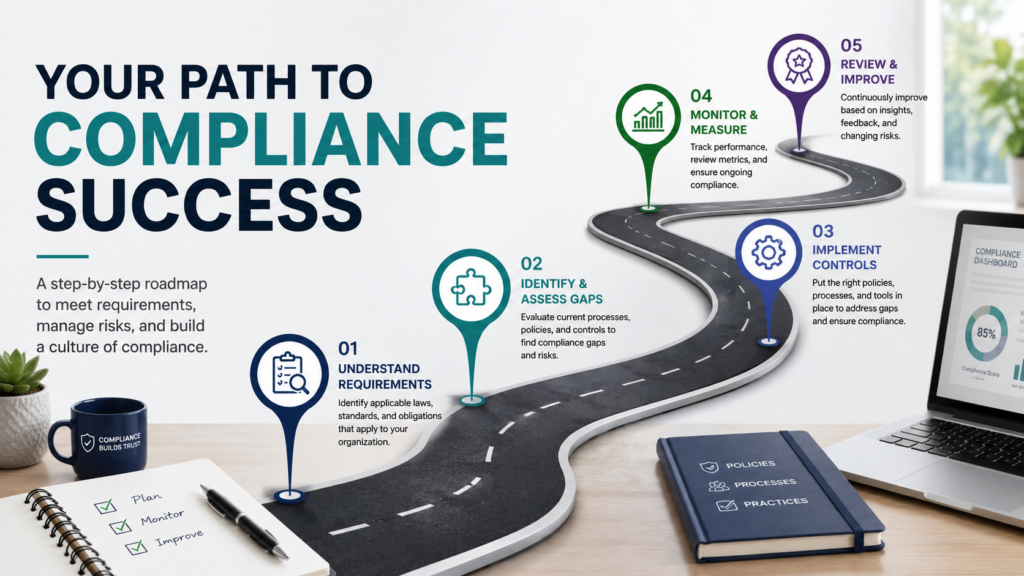
Pulling all of this into a workable path forward, a few steps tend to matter most. Start by mapping every legal requirement that applies to your industry and location, since gaps often hide in details rather than headlines. From there, run a hazard-specific risk assessment rather than relying on a generic checklist someone downloaded once. Train every employee and document every session as you go. Post required notices where employees can actually see them, not buried in a back office. Build a reporting process for incidents and near-misses alike, so small issues surface before they become large ones. Layer wellness programs on top of compliance rather than treating them as a substitute for it. And audit the whole system at least once a year, since each of these steps closes a different gap, and skipping even one lets exposure grow quietly in the background.
Why Getting This Right Matters
Employee wellbeing legal requirements protect more than the business itself. They protect real people, and a missed hazard can mean a serious injury, just as a skipped report can mean a death goes unrecorded entirely.
The financial stakes are real too, and they compound in ways that aren’t always obvious upfront. Citations carry fines, lawsuits carry settlements, and turnover carries hidden costs that rarely show up on a single line item, even though they add up quickly across a year.
Reputational damage compounds everything else on top of the financial picture. News of a workplace injury spreads fast in a connected world, job seekers research employer safety records before even applying, and a poor record tends to follow a company for years afterward.
These rules also shift over time, which is easy to forget once a policy feels settled. What satisfied regulators five years ago may not satisfy them today, since standards tighten and enforcement increases steadily, which means staying static simply isn’t a realistic option anymore.
Common Mistakes Employers Make
Many employers assume one safety manual covers every requirement they face. It doesn’t, since different hazards need different controls tailored to the actual risk involved.
Some employers train once and never again, which leaves new hires missing critical information that everyone else absorbed early on. Refresher training closes that gap reliably, and it doesn’t need to be elaborate to work.
Others document poorly, treating a verbal warning as though it carries the same weight as a written one. It doesn’t. If it isn’t written down, regulators and courts may treat the conversation as though it never happened at all.
A few employers treat employee wellness programs as a complete answer, which, as covered above, is genuinely risky. Wellness perks support compliance, but they don’t replace it, no matter how generous the program looks on paper.
Finally, many employers underestimate state-level rules entirely. Federal law sets a floor, but state law can raise it significantly, and ignoring state requirements remains one of the most common, and most costly, oversights employers make.
Conclusion
Employee wellbeing legal requirements demand real action, not paperwork alone, and that distinction shapes everything else in this guide. Depending on the applicable jurisdiction, industry, and workplace hazards, employer legal responsibilities may include hazard identification, training, incident reporting, recordkeeping, and ongoing review.
These daily habits, taken together, turn legal obligations into routine practice rather than periodic scrambling. Wellness perks add real value, but only alongside genuine compliance work underneath them, and employee well-being and workplace well-being both depend on consistent follow-through far more than they depend on good intentions alone.
Get the basics right, document everything as you go, and review often rather than waiting for a problem to force the issue. That’s how employee wellbeing legal requirements stop feeling like a list of boxes to check and start becoming a genuine foundation for a safer, stronger organization instead.
Frequently Asked Questions
Yes. Size affects which specific standards apply, but the core legal duty to provide a safe, healthy workplace never shrinks with employee headcount.
In some jurisdictions, yes. Occupational health and safety laws increasingly recognize psychosocial risks, while mental health claims may also fall under employment, disability, anti-discrimination, or workers’ compensation laws depending on the circumstances.
No. Employee wellness programs boost morale but don’t replace hazard-specific duties. Compliance requires documented risk assessments, training records, and consistent reporting alongside any wellness perks.