

Manufacturing is often discussed in terms of output – production targets, quality metrics, supply chain efficiency, and unit economics. What gets discussed far less frequently is the human experience of the people who sustain that output, shift after shift, in environments that are physically demanding, repetitive, and often high-stakes. The mental health of the manufacturing workforce is a significant and underaddressed concern, and the organizations that ignore it are paying a price they may not always be measuring clearly.
The evidence is compelling. Among detailed industry groups analyzed by the CDC, Aerospace Products and Parts Manufacturing recorded one of the highest suicide rates among male workers at 147.5 per 100,000 population. More broadly, the suicide rate among the U.S. working-age population has increased approximately 33 percent over the last two decades, with installation, maintenance, and repair occupations – closely aligned with manufacturing roles – among the groups with the highest elevated rates. Manufacturing also accounted for a significant share of synthetic opioid and stimulant co-involved overdose deaths by industry in 2022, reflecting the intersection of physical injury, pain management, and substance use that characterizes many production environments.
These are not abstract statistics. They describe the workforce behind some of the economy’s most essential industries, and they make a clear case for structured, professional mental health support. An EAP for manufacturing provides exactly that.
Understanding the Employee Assistance Program
An employee assistance program, or EAP, is a confidential workplace benefit that connects employees with professional support services, typically encompassing mental health counseling, crisis intervention, substance use support, financial guidance, and legal referrals. While EAPs have existed across various industries for decades, their penetration and adaptation within manufacturing has lagged, despite the sector’s disproportionate exposure to occupational stressors.
An EAP for manufacturing must account for the specific operational realities of the sector. Workers operate across multiple shifts, often in loud, physically demanding environments with limited access to privacy or digital communication during working hours. Many manufacturing roles carry inherent physical risk, and the cultural norms that prevail on most production floors have historically discouraged open discussion of mental health. A generic EAP framework that does not account for these operational realities may be less accessible and less relevant to manufacturing employees. An EAP for manufacturing, by contrast, is built around these realities from the outset.
Manufacturing Mental Health: A Problem Hidden in Plain Sight
Manufacturing employees may experience mental health challenges influenced by a combination of occupational and personal factors. Physical injury, chronic pain, shift work, and workplace stress can all affect wellbeing, while substance use concerns may also require appropriate professional support. These overlapping challenges highlight the importance of accessible employee assistance and referral services.
Beyond injury-related pathways, the structural conditions of manufacturing work generate their own mental health pressures. Repetitive tasks, rotating shifts, noise exposure, and the ever-present awareness of production targets create a sustained low-level stress that accumulates over time. Job insecurity, particularly during periods of automation-driven restructuring, adds a further layer of anxiety. Research from Mind Share Partners found that employees who work at a company that supports their mental health are twice as likely to report no burnout or depression – a finding with direct operational implications in a sector where burnout-driven errors can have serious safety consequences.
Manufacturing mental health is not a peripheral concern. It sits at the intersection of workforce stability, safety performance, and organizational resilience.
Manufacturing Employee Wellness and the Safety Imperative
Manufacturing employee wellness has an important connection to workplace safety. Fatigue, stress, or other factors that affect concentration and judgment can create additional challenges in environments involving heavy machinery, hazardous materials, or physically demanding work. Organizations should therefore consider psychological wellbeing alongside physical safety as part of a broader approach to protecting employees.
Sustained job stress can affect employee wellbeing and may contribute to difficulties with concentration, sleep, and overall functioning. In manufacturing environments, where employees often work around physical hazards, organizations should consider how workplace conditions and employee wellbeing may interact with broader safety risks.
Investing in manufacturing employee wellness through a structured EAP for manufacturing is therefore not only a question of organizational ethics. It is an occupational safety imperative, one that extends the concept of workplace safety beyond physical hazards to encompass the psychological conditions in which work takes place.
Workplace Wellbeing in Manufacturing: The Cultural Challenge
Workplace wellbeing in manufacturing faces a cultural obstacle that few other industries share to the same degree. Production floor culture has long prized physical toughness, stoicism, and the ability to push through difficulty without complaint. In many manufacturing environments, discussing mental health openly remains stigmatized, and workers who seek help risk being perceived as weak or unreliable by colleagues and supervisors alike.
Changing workplace culture requires deliberate and consistent effort. Employees may hesitate to discuss mental health concerns or seek support when they fear stigma, lack awareness of available resources, or are uncertain about how to access them. Manufacturing organizations should therefore communicate available support clearly and repeatedly through channels that reach employees across different roles and shifts.
An EAP for manufacturing supports genuine workplace wellbeing not only by providing direct support to individuals, but by equipping supervisors to recognize distress, normalize help-seeking behavior through consistent communication, and model a culture in which psychological health receives the same serious attention as physical safety. Workplace wellbeing in manufacturing improves most durably when cultural change and practical support infrastructure develop together.
How Employee Wellness Programs Must Adapt for Manufacturing
Most employee wellness programs are designed with office-based workers in mind – consistent schedules, desk access, reliable internet connectivity, and time during the working day to engage with digital resources. Manufacturing environments share few of these characteristics.
Workers on rotating shifts may never interact with standard employee communications delivered during day-shift business hours. Many do not have regular computer access during their working day. Shift handovers, production pressure, and the physical demands of the work leave little space for the kind of engagement that general employee wellness programs assume.
To function effectively in this context, employee wellness programs for manufacturing need to be accessible via mobile devices, available across all shift patterns, and simple enough to use quickly. Peer support programs, trained mental health champions embedded within production teams, and brief toolbox-style mental health talks delivered at shift change can all increase reach significantly beyond what a digital-first program alone would achieve.
An EAP for manufacturing should be designed around production floor realities rather than relying solely on corporate communication norms. Mobile access, support across different shift patterns, and clear communication through workplace channels can help make the program more accessible to employees.
Corporate Wellness Programs Versus Manufacturing-Specific EAP Support
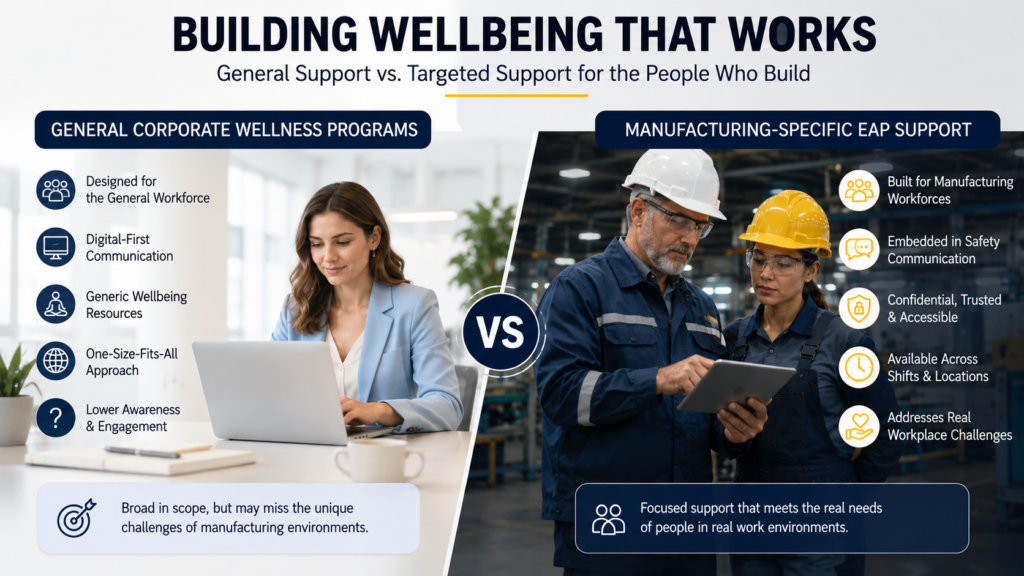
Many manufacturing organizations maintain some form of corporate wellness programs, often including general health screenings, fitness benefits, or occasional wellness communications distributed through HR channels. These corporate wellness programs can provide valuable general support, but organizations may need to adapt them to address the specific operational realities of production environments.
Burnout and poor employee wellbeing can create significant organizational challenges, including absenteeism, disengagement, and workforce instability. In manufacturing, organizations should also consider how fatigue, staffing pressures, and employee wellbeing interact with the operational and safety demands of production environments.
Standard corporate wellness programs were not designed to address the specific intersection of physical injury, substance use risk, job insecurity, and shift-pattern disruption that characterizes manufacturing work. An EAP for manufacturing functions most effectively as a targeted, sector-specific complement to broader corporate wellness programs, addressing the dimensions of occupational stress that general wellness initiatives do not adequately reach.
Core Components of an Effective EAP for Manufacturing
A well-designed EAP for manufacturing incorporates several defining elements.
Round-the-clock confidential counseling is foundational, ensuring that support remains accessible across all shift patterns and is not restricted to standard business hours that many manufacturing workers never work.
Substance use support with clinical expertise in injury-related pain management and opioid dependence is particularly important given the documented rates of substance use disorders within the manufacturing workforce.
Critical incident support following accidents, near-misses, or traumatic events on the production floor provides immediate professional response at the moment it is most needed, rather than leaving workers to manage acute psychological trauma without assistance.
Supervisor and team leader training equips line managers to recognize early indicators of psychological distress, reduce stigma through their own conduct and communication, and direct workers toward appropriate support without judgment.
Financial and legal guidance addresses the job insecurity anxiety that many manufacturing workers experience during periods of restructuring, automation adoption, or economic uncertainty, providing practical support for a significant source of occupational stress.
Multilingual access reflects the workforce diversity present in many manufacturing facilities, ensuring that language does not become a barrier to professional support.
Together, these components establish an EAP for manufacturing as a substantive, operationally integrated resource rather than a benefit that exists only in policy documentation.
The Business Case for an EAP for Manufacturing
Poor employee wellbeing, absenteeism, burnout, and workforce instability can create significant operational and financial challenges. In manufacturing, where staffing levels and workforce capacity play an important role in production, organizations should consider employee wellbeing as part of their broader approach to workforce planning and operational resilience.
Employee wellbeing can influence engagement, attendance, and the ability to manage demanding work. In manufacturing environments, organizations should consider mental health support alongside broader efforts to address workplace safety, staffing, fatigue, and operational conditions. An EAP can provide confidential professional support, but its effect on organizational outcomes will depend on program design, employee needs, workplace conditions, and other actions taken by the organization.
An EAP for manufacturing can form a valuable part of a broader workforce wellbeing strategy by providing employees with access to confidential professional support. Organizations should combine this support with wider efforts to address workplace conditions, safety, staffing, and other factors that influence employee wellbeing.
Implementing an EAP for Manufacturing
Effective implementation of an EAP for manufacturing requires more deliberate communication planning than is typical in other sectors. Beginning with an anonymous workforce survey to identify the most significant sources of stress, whether physical injury, shift fatigue, job insecurity, or financial pressure, provides an evidence base for program design rather than relying on assumptions.
Provider selection should prioritize demonstrated experience with manufacturing or industrial workforces, given that the occupational context is materially different from general corporate environments. Programs should offer genuine around-the-clock access, mobile-friendly resources, and multilingual support. Peer advocate programs, training selected workers on the production floor to serve as first points of contact and awareness champions, can substantially increase program reach and uptake in environments where digital communication is limited.
Organizations should integrate program communication into existing safety communication channels, including toolbox talks, shift briefings, and safety notice boards, instead of relying solely on email or HR channels that may not reach all workers effectively. They should also clearly and consistently explain how the program protects confidentiality, as employees are more likely to engage with the service when they understand and trust its privacy arrangements.
Conclusion
Manufacturing’s workforce is essential to economic function, and it operates under conditions that generate sustained psychological strain. The intersection of physical risk, repetitive work, substance use vulnerability, shift disruption, and cultural stigma around mental health creates a profile of need that standard wellness initiatives rarely address adequately.
An EAP for manufacturing provides a structured, professionally delivered, and operationally adapted response to this documented reality. It supports manufacturing mental health at an individual level, strengthens manufacturing employee wellness across the workforce, and advances workplace wellbeing as a genuine organizational priority. Integrated alongside broader employee wellness programs and complementing existing corporate wellness programs, it ensures that the people sustaining production every day have access to the same quality of professional support available in any other sector.
Organizations that invest in meaningful employee support can strengthen their broader approach to workforce wellbeing. An EAP can complement efforts to address workplace safety, staffing, working conditions, and operational challenges that influence both employee wellbeing and organizational performance.
Frequently Asked Questions
A combination of physical injury risk, substance use vulnerability, rotating shifts, limited digital access, and deeply embedded cultural stigma around help-seeking makes manufacturing mental health uniquely challenging to address through standard programs.
An EAP for manufacturing can provide confidential support for employees experiencing stress, mental health concerns, substance use challenges, or personal difficulties. While an EAP alone cannot determine workplace safety outcomes, it can form part of a broader approach that supports employee wellbeing alongside established safety practices and efforts to address workplace risks.
Yes. An effective EAP for manufacturing provides around-the-clock access via phone and mobile channels, ensuring support is available across all shift patterns rather than only during standard business hours.