

Healthcare costs for U.S. employers hit a new high in 2025. Average annual premiums for employer-sponsored family health coverage reached $26,993 – a 6% increase over 2024, according to the KFF Employer Health Benefits Survey. Early forecasts for 2026 project even higher costs.
At the same time, 129 million Americans – nearly 40% of the population – live with at least one chronic condition. Chronic and mental health conditions now account for 90% of the nation’s annual healthcare expenditures. For employers, this is not an abstract public health statistic. It is a direct financial and operational challenge.
The solution isn’t simply spending more on employee benefits. It is spending smarter, with a structured, data-driven strategy that improves workforce health at scale.
That strategy is population health management for employers.
What Is Population Health Management?
Population health management (PHM) is a proactive, data-driven approach to improving the overall health of a defined group of people. For employers, that group is their workforce.
Rather than responding to health problems after they become expensive – hospitalizations, emergency care, chronic disease complications – population health management employer programs identify risk early and intervene before costs spiral.
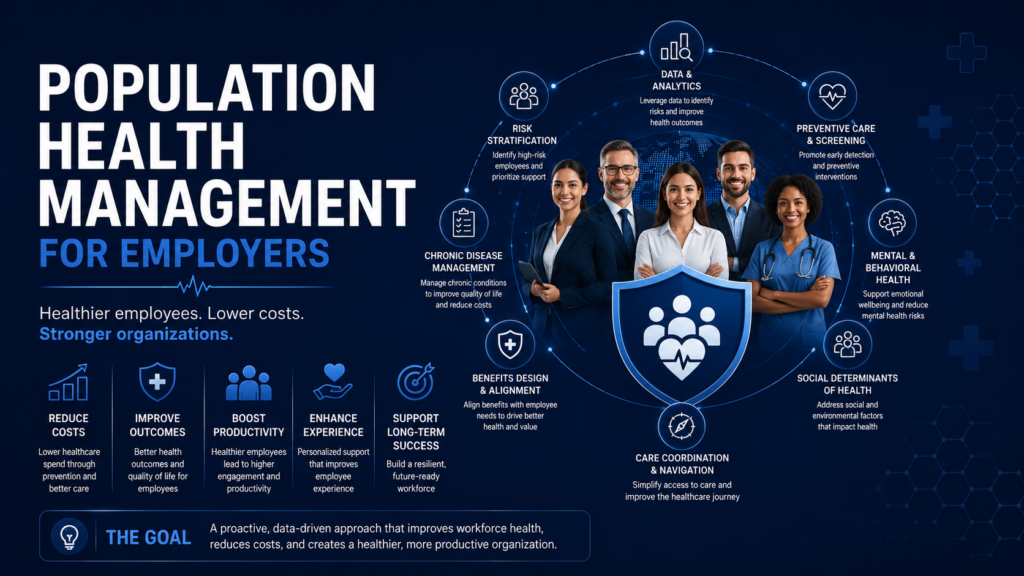
PHM is not a single program. It is an overarching strategy that integrates:
- Health data collection and analytics
- Risk stratification and population segmentation
- Preventive care and early screening
- Chronic disease and care management
- Mental health and behavioral health support
- Benefits design and care navigation
- Workplace environment improvements
- Social determinants of health (SDOH) assessment
The goal is to move the entire workforce toward better health outcomes – reducing costs, improving productivity, and building a more resilient organization.
Why Population Health Management Matters for Employers
The financial case for employer population health management is grounded in data.
CDC research has estimated substantial national productivity losses associated with chronic health conditions and risk factors. For individual employers, absenteeism costs from conditions such as hypertension, diabetes, obesity, and smoking can add up significantly as health risks accumulate.
Financial stress, including debt, can contribute to poorer mental health and make it harder for employees to manage other health needs. When mental health conditions intensify, physical health challenges follow. And unmanaged physical conditions reduce workplace performance, increase absenteeism, and generate high-cost insurance claims.
The data from self-insured employers is particularly compelling. A Taft-Hartley fund working with Conifer Health on a structured PHM program achieved nearly $1 million in savings with 91% employee engagement. Well-designed population health management programs can help employers manage plan costs, address high-cost claims, and support workforce productivity.
Beyond savings, population health management in the workplace addresses a strategic talent issue. Employee benefits can play an important role in recruitment, retention, and overall employee satisfaction.
The Pillars of Effective Population Health Management
Managing a workforce’s health at scale requires more than good intentions – it requires a structured framework built on eight interconnected pillars.
1. Data Collection and Analytics
You cannot manage what you cannot measure. Effective PHM draws on medical claims, biometric screenings, HRAs, EAP utilization, absenteeism records, and social determinants data. Modern platforms consolidate these sources to identify risk patterns and flag gaps in care. Non-clinical signals can also provide useful context, including indicators of financial stress that may affect healthcare access and employee wellbeing.
2. Risk Stratification
Once data is assembled, segment your workforce into high-, moderate-, and low-risk tiers. High-risk employees – those with multiple chronic conditions or frequent hospitalizations – generate the majority of healthcare costs and need intensive clinical support. Moderate-risk employees need early intervention before conditions worsen. Low-risk employees need prevention programs that keep them healthy. Without stratification, resources go to the wrong people and high-cost employees go unsupported.
3. Personalized Care Management
High-risk employees – including those with multiple chronic conditions or frequent hospitalizations – often account for a disproportionate share of healthcare spending and may need more intensive clinical support – including case management for complex conditions, disease management programs for diabetes, hypertension, and cardiovascular disease, utilization management to avoid unnecessary ER visits, and care coordination across primary care, pharmacy, and behavioral health. Focusing on the individual – not just the diagnosis – reduces avoidable costs and prevents catastrophic claims.
4. Preventive Care and Health Promotion
Prevention is a central component of an effective PHM strategy. Identifying and addressing health risks early can help employers reduce the likelihood of costly complications and intensive treatment. Key components include biometric screenings, age-appropriate cancer screenings, blood pressure and glucose monitoring, vaccination programs, and lifestyle interventions covering nutrition, physical activity, and tobacco cessation. The National Diabetes Prevention Program alone reduces Type 2 diabetes risk by 58% in high-risk individuals.
5. Mental Health Integration
Mental and physical health are closely connected and can benefit from coordinated support. Employees with unmanaged mental health conditions miss more work, underperform, and generate higher long-term medical claims. Effective PHM integrates real-time EAP access, digital therapy platforms, stress management programs, financial wellness support, and manager training on psychological safety. Financial wellbeing can also affect mental health and an employee’s ability to engage with healthcare, making it a relevant consideration in whole-person population health strategies.
6. Benefits Design and Plan Optimization
Benefits structure is one of the most underutilized population health tools available to employers. Plan design changes directly influence how employees access and use care. Waiving copays for preventive visits, reducing out-of-pocket costs at high-value care settings, incentivizing screening completion, and ensuring affordable access to chronic disease medications all shift utilization toward lower-cost, higher-value care and potentially reduce avoidable healthcare spending over time.
7. Social Determinants of Health (SDOH)
Health outcomes are shaped by far more than clinical care. Food access, housing stability, transportation, and financial security can significantly influence health outcomes and access to care. Employers who address SDOH – through healthy food benefits, care navigation services, multilingual communications, and transportation support – reach the root causes that clinical programs alone cannot fix. Ignoring SDOH systematically limits PHM effectiveness.
8. Workplace Environment and Culture
The physical and cultural work environment is itself a health intervention. What employees eat, how much they move, how stressed they feel, and how psychologically safe they feel during the workday are all shaped by employer decisions. Stocking cafeterias with heart-healthy options, offering fitness access, creating walking paths, reducing systemic overwork, and building policies that reduce stigma around seeking care can influence workforce health, employee wellbeing, and healthcare utilization over time.
Benefits of Population Health Management for Employers
A well-executed PHM strategy doesn’t just improve health outcomes – it directly improves the bottom line.
| Benefit Area | Impact |
|---|---|
| Reduced Healthcare Costs | Fewer high-cost claims, hospitalizations, and emergency care events through early intervention |
| Lower Absenteeism | Each chronic condition costs employers $2B+ annually in absenteeism nationally; PHM reduces this burden |
| Improved Presenteeism | Employees with managed conditions perform at significantly higher on-the-job capacity |
| Better Retention | Benefits quality is the #2 reason employees leave; robust PHM differentiates employer value |
| Catastrophic Claim Avoidance | Medication adherence and care gap closure prevent the most expensive health events |
| Mental Health ROI | Early behavioral health access produces downstream reductions in absenteeism and medical spend |
| SDOH-Informed Savings | Addressing food, financial, and housing stress reduces healthcare utilization and improves engagement |
| Workforce Equity | Targeted programs for high-risk groups improve health outcomes and reduce disparities |
How Employers Can Build a Population Health Management Program
“The secret of getting ahead is getting started.” – Mark Twain
Building a PHM program doesn’t require a complete benefits overhaul. It requires the right sequence of steps – and the discipline to follow them.
Step 1 – Know Your Population
Analyze claims data, biometric screening results, HRA responses, absenteeism records, and EAP utilization. Identify which conditions are driving the highest costs. Look beyond clinical data – monitor 401k participation, workers’ comp trends, and short-term disability patterns for early signals of broader workforce health challenges.
Step 2 – Stratify Your Risk
Segment employees into high-, moderate-, and low-risk tiers. Direct intensive care management resources toward employees with the highest health risks and healthcare needs. Design general wellness programs for the broader workforce. Ensure neither group is neglected.
Step 3 – Design Targeted Interventions
Build specific programs for your top three to five cost drivers. If your data shows elevated diabetes and hypertension claims, design dedicated disease management tracks. If mental health conditions dominate, invest in EAP access and digital therapy. Let the data drive intervention design – not assumptions.
Step 4 – Optimize Your Benefits Structure
Redesign plan incentives to support the behavior changes your PHM strategy requires. Waive copays for preventive visits. Reduce out-of-pocket costs at high-value care settings. Incentivize screening participation. Eliminate cost barriers to chronic disease medication.
Step 5 – Address Social Determinants
Survey employees (anonymously) to understand the social and environmental factors affecting their health. Adjust benefits, communications, and workplace programs based on what you find. PHM programs that overlook relevant social and environmental barriers may have difficulty reaching employees who need support most.
Step 6 – Integrate Mental and Physical Health
Ensure mental health support is embedded in your PHM strategy – not bolted on as an afterthought. Real-time EAP access, digital therapy tools, financial wellness support, and manager training all belong in a comprehensive PHM framework.
Step 7 – Communicate Clearly and Consistently
Many employees don’t engage with PHM programs because they don’t know they exist. Use multiple channels – email, manager briefings, benefits portals, wellness fairs, and on-site events – to drive awareness. Emphasize confidentiality. Make participation easy and accessible for all employee groups.
Step 8 – Measure, Report, and Refine
Establish measurable KPIs before launch. Track: screening completion rates, high-risk employee engagement, claims cost trends, absenteeism changes, mental health utilization, and program ROI. Review annually. Replace underperforming vendors. Expand programs that demonstrate results.
Emerging Trends in Employer Population Health Management
The employers winning on workforce health in 2026 aren’t reacting to trends – they’re already building around them.
AI-Powered Risk Prediction
Artificial intelligence is transforming how employers identify high-risk employees. AI platforms can analyze claims, biometric, pharmacy, and HRA data to identify patterns associated with higher health risks and support proactive outreach. The ability to analyze social determinants data further enhances the precision of population health strategies for employers by addressing underlying factors that influence outcomes.
Integrated Cardiometabolic Management
Diabetes, obesity, hypertension, and cardiovascular disease share overlapping risk factors and often co-occur. Employer population health management programs are increasingly exploring integrated cardiometabolic approaches that address these overlapping risk factors together rather than treating each condition in isolation.
GLP-1 Integration With Behavioral Support
GLP-1 medications are reshaping the management of obesity and Type 2 diabetes in employer populations. But medication alone does not sustain outcomes. PHM strategies can combine GLP-1 access with behavioral coaching, nutrition support, and activity programs to provide broader support for employees using these medications.
SDOH-Informed Data Platforms
PHM technology platforms are increasingly integrating non-clinical data – including housing stability, food access, financial health, and neighborhood-level health risk data – into risk scores and intervention workflows. Early movers in this space are unlocking value that purely clinical analytics cannot capture.
Value-Based Care Alignment
Some self-insured employers are exploring outcome-based contracts with PHM vendors and healthcare providers, linking part of vendor compensation to agreed-upon health and cost outcomes. This alignment creates shared financial incentives for genuine population health improvement.
Whole-Person Care as the New Standard
Employers are moving beyond the fragmented point-solution model – where separate vendors manage diabetes, mental health, MSK, and wellness in silos – toward integrated whole-person care platforms. This approach can reduce administrative complexity, improve the employee experience, and support more coordinated care.
Conclusion
The workforce health challenge facing employers in 2026 is not going away. Healthcare premiums are rising. Chronic conditions are becoming more prevalent. Mental health needs are intensifying. Social and financial stressors are compounding clinical risk.
A fragmented response – point solutions addressing each condition in isolation – cannot match the scale or complexity of this challenge.
Population health management for employers offers a strategic alternative. It treats the workforce as a population, uses data to understand it, stratifies risk to prioritize resources, and deploys coordinated interventions across clinical, behavioral, environmental, and social dimensions.
Employers can strengthen the value of their health strategy by moving beyond reactive benefits management toward proactive, integrated population health management. They can close gaps in care, reduce the risk of high-cost events, and support workforces that are healthier, more engaged, and more productive.
That is the promise of population health management for employers. For organizations willing to make the strategic commitment, a well-designed PHM strategy can support better health outcomes, more effective resource allocation, and stronger workforce health.
Frequently Asked Questions (FAQs)
PHM can help prevent costly complications through early intervention, close gaps in care, support medication adherence, and potentially reduce avoidable absenteeism and high-cost claims.
Effective PHM draws on medical claims, biometric screenings, HRAs, EAP utilization, absenteeism records, and non-clinical signals like 401k participation, workers’ comp trends, and social determinants data.
Social determinants of health can have a substantial influence on health outcomes and access to care. Employees facing food insecurity, debt, or housing instability may face additional barriers to benefiting from clinical PHM programs unless those underlying challenges are also addressed.