

Psychological safety at the workplace isn’t just a buzzword, though it’s often treated that way. It’s a genuine business fundamental, and the difference between teams that have it and teams that don’t shows up clearly in performance, retention, and how honestly people speak up when something’s gone wrong.
The term gets used loosely in leadership decks and onboarding materials, often as shorthand for “be approachable” or “keep an open door.” That’s a fairly surface-level read. Real psychological safety runs deeper than tone alone. It shapes whether people feel comfortable telling the truth when it’s inconvenient, and just as importantly, whether leaders are genuinely able to hear it when they do.
In this guide, we’ll walk through what psychological safety actually means, look at the research behind it, and share practical steps for building it intentionally rather than hoping it happens on its own.
What Is Psychological Safety at the Workplace?
At its core, it means people feel safe speaking up. They can share ideas without fear of embarrassment, and they can admit mistakes without facing punishment for doing so. Harvard researcher Amy Edmondson coined the term decades ago, and her framework still shapes how we understand effective teams today.
It’s worth noting that psychological safety isn’t the same thing as comfort, and that distinction trips a lot of well-meaning leaders up. Also, it is not about avoiding hard conversations altogether. Neither is it about making sure people can have those conversations honestly, without putting their standing on the team at risk. – workplace psychological safety tends to reveal itself in small, easy-to-miss moments rather than grand gestures. A junior employee gently questions a decision in a meeting. A team member flags a mistake early, before it becomes a much bigger problem. These moments only happen consistently when people trust that the response will be constructive rather than punitive, and that trust gets earned gradually, through repeated experience.
The research here is genuinely compelling. Google’s well-known Project Aristotle identified psychological safety as the most important of five key dynamics associated with effective teams. The research highlighted the importance of creating an environment where team members feel comfortable taking interpersonal risks, including speaking up, asking questions, and admitting mistakes.
What made Project Aristotle especially notable was how surprising the findings were, even to the researchers conducting the study. They had expected the strongest teams to share traits like seniority, technical skill, or a particular mix of personalities. Instead, the clearest predictor turned out to be something far less visible: whether team members felt safe taking interpersonal risks in front of one another. Skill, it turned out, mattered considerably less than trust.
Why Psychological Safety at the Workplace Is Still Rare
Despite this strong body of evidence, most workplaces still fall short. Research from McKinsey indicates that only 26% of leaders create psychological safety for their teams, a striking gap between what the data clearly supports and what’s actually happening day to day.
Team climate matters more than many leaders realize here. McKinsey’s research also found that just 43% of surveyed employees say their team has a positive climate, identified as the single most important driver of psychological safety at the workplace. That leaves a majority of teams operating without the foundation they genuinely need to thrive.
It’s also worth saying that employees clearly want this; it’s far from a fringe preference. Oyster HR’s research found that psychological safety ranks among the top three workplace priorities for employees, trailing only regular pay raises and flexible work arrangements. It sits close to the center of how people experience their jobs, not somewhere near the bottom of the list.
Unfortunately, it tends to erode quietly, without any single dramatic event causing the decline. It happens instead through small, repeated signals: a dismissed idea here, a public correction there, a leader who shuts down disagreement once too often. Over time, people understandably stop speaking up, and silence becomes the safer, more rational choice given what they’ve observed.
The Four Stages of Psychological Safety
Psychological safety doesn’t appear all at once. Timothy R. Clark’s four-stage model describes a progression from feeling included and accepted to feeling safe to learn, contribute, and ultimately challenge the status quo.
The first stage is inclusion safety, where people need to feel genuinely accepted simply for being part of the team before anything else can develop on top of that. Without this foundational layer in place, little else tends to matter much.
The second stage is learner safety: the freedom to ask questions, experiment, and make honest mistakes while developing a new skill. Teams that punish learners for stumbling rarely end up with confident, capable employees later on, since the punishment teaches people to stop trying rather than to keep improving.
The third stage is contributor safety, where people feel comfortable using their skills to make a meaningful difference, offering ideas and taking initiative without needing constant approval first.
The fourth and final stage, challenger safety, is the hardest one to build, and arguably the most valuable. It’s the freedom to question the status quo, challenge a leader’s decision, or point out a flaw in the plan without fear of retaliation. Teams that reach this stage tend to outperform everyone else, simply because nothing important goes unsaid for long.
Most organizations stall somewhere between learner and contributor safety, and relatively few ever reach genuine challenger safety. That gap helps explain why good ideas so often quietly die in meetings instead of getting raised at all.
The Business Case
This isn’t simply a feel-good initiative tacked onto a wellness program. It drives measurable outcomes that show up clearly in real business metrics.
Productivity tends to rise when people feel safe, since teams communicate more openly, catch errors earlier, and solve problems faster, freeing up energy that would otherwise go toward managing fear.
Innovation also depends on employees feeling comfortable sharing unfinished or unconventional ideas without fear of ridicule. Psychological safety supports team learning, open communication, experimentation, and collaboration, all of which can create stronger conditions for innovation. Teams that punish failure rarely encourage people to take the interpersonal risks that meaningful learning and improvement often require.
Retention is perhaps where the impact becomes hardest to overlook. BCG research found that the positive effects of psychological safety can be particularly pronounced for diverse and disadvantaged employee groups. In its analysis, retention increased by more than four times for women and BIPOC employees, five times for employees with disabilities, and six times for LGBTQ+ employees when leaders successfully created psychological safety.
Leadership development hasn’t fully caught up with this reality yet, either. Nearly half of CHROs still cite leadership and manager development as their top priority, for the second year running. Organizations clearly recognize that their leaders need to grow in this area; many simply haven’t built the systems yet to make that growth happen reliably.
Wellbeing and Psychological Safety
Employee wellbeing and psychological safety are deeply connected, to the point where one rarely exists for long without the other.
When people feel unsafe speaking up, stress tends to build quietly in the background. They carry unresolved concerns home with them, and they second-guess their own judgment more than they probably should. Wellbeing suffers in ways that don’t always show up immediately, but that accumulate steadily over time.
The connection runs in both directions, too. Strong employee wellbeing programs tend to fall flat in environments without underlying trust. A counseling benefit means relatively little if employees fear judgment for actually using it. Psychological safety has to come first, since most everything else gets built on top of it, rather than the other way around.
This same foundation matters deeply here as well. Workplace mental health isn’t only about having access to resources or benefits on paper. It’s about whether people feel safe disclosing a struggle in the first place, and an employee navigating anxiety is unlikely to ask for help in a culture that quietly punishes vulnerability.
Leaders sometimes assume mental health and performance pressure are entirely separate issues. They really aren’t. Workplace mental health and psychological safety reinforce each other constantly, and a team that normalizes honest conversation about workload and stress tends to catch burnout early, well before it turns into a larger crisis.
Engagement and the Trust Gap
Employee engagement and psychological safety tend to move together, almost without exception. More than half of US employees report feeling disengaged or simply going through the motions at work, and that figure likely reflects a deeper trust problem rather than a motivation problem on its own.
People tend to disengage when speaking up starts to feel risky. They stop offering ideas, do the minimum required, and quietly protect themselves instead. Engagement drops not because people stopped caring, but because caring stopped feeling safe somewhere along the way.
Rebuilding employee engagement often starts with smaller signals than leaders expect going in. A manager who responds to a flagged mistake with curiosity instead of blame sends a genuinely powerful message. A team that debriefs honestly after a setback, without assigning individual blame, tends to build trust faster than almost anything else a leader can do deliberately.
How to Build This Kind of Safety
Building workplace psychological safety takes consistent, ongoing effort. It isn’t something a single training session can achieve, and it certainly isn’t a poster on the wall.
Leadership Behavior
It helps to start with leadership behavior, since leaders set the tone every single day, whether they intend to or not. How a leader responds to bad news shapes whether people feel comfortable sharing bad news again in the future. Punish the messenger once, and the messages tend to stop coming after that.
Normalizing Mistakes
It’s also worth normalizing mistakes as data rather than as failure. Teams that treat errors as useful information tend to learn faster than teams that treat them as something to hide. Running blameless post-mortems, with a focus on what happened and why rather than who’s at fault, can make a real difference here.
Inviting Dissent
Inviting dissent directly, rather than waiting for disagreement to surface on its own, is another helpful practice. A simple, sincere question like “What am I missing here?” signals clearly that pushback is genuinely welcome rather than something to be avoided.
Modeling Vulnerability
Modeling vulnerability from the top down matters too. A leader who’s willing to admit uncertainty, or even a past mistake, gives everyone else implicit permission to do the same. Workplace psychological safety tends to grow fastest when it starts at the top and moves downward through the organization.
Respond Visibly
Closing the loop on feedback is equally important. When someone raises a concern, responding visibly, even with a simple acknowledgment, makes a real difference. Silence after a disclosure can quietly teach people not to bother raising anything next time.
Finally, it helps to train managers specifically, since most were promoted for technical skill rather than emotional intelligence. Equipping them with concrete tools- how to run a debrief, how to respond to disagreement, how to handle a disclosure about stress or mental health thoughtfully- goes a long way.
Building the Culture Around Psychological Safety at the Workplace
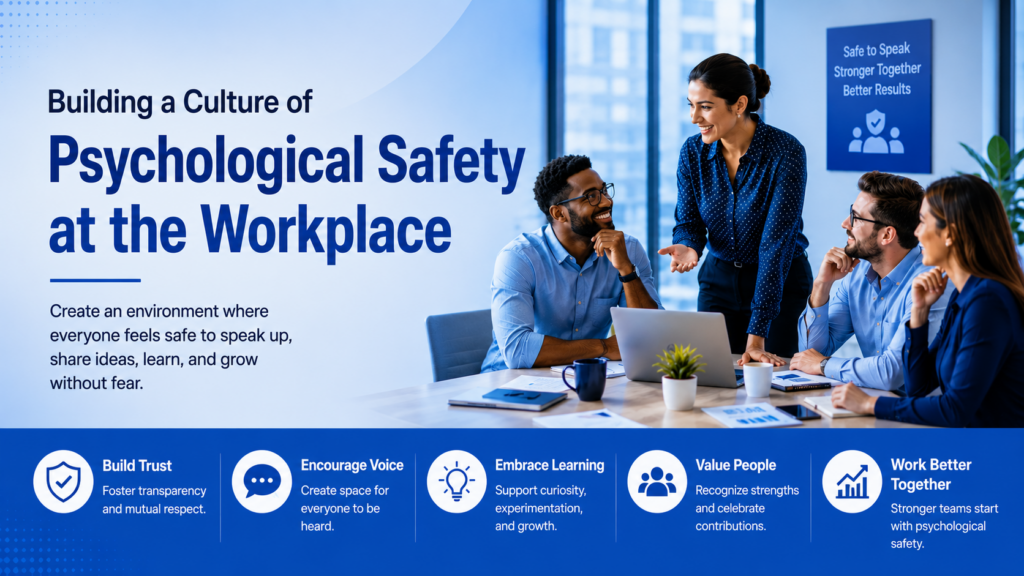
A strong culture doesn’t happen by accident; it gets built deliberately, through consistent practices repeated over a long stretch of time.
Healthy workplace culture starts with basic clarity. People need to understand expectations, roles, and how decisions actually get made around them. Ambiguity tends to breed anxiety, and anxiety, in turn, quietly undermines safety.
Recognition plays a meaningful role too. A healthy workplace culture celebrates honest contributions, not just successful outcomes. Someone who flags a risk early deserves genuine recognition, even if the project still ends up struggling despite the early warning.
Consistency matters far more than grand gestures here. One inspiring speech about openness won’t undo months of punitive reactions to bad news. Small, repeated behaviors build trust steadily, while small, repeated betrayals can undo that trust just as quickly.
Measuring Progress
The good news is that psychological safety at the workplace can be measured, even though it can feel intangible on the surface. Short, anonymous pulse surveys work well for this purpose. Direct questions tend to work best: Do you feel safe raising concerns? Do you feel comfortable disagreeing with your manager openly?
It’s worth tracking patterns over time rather than relying on single snapshots. A dip after a layoff or restructuring is expected and usually temporary. A sustained decline, on the other hand, signals a deeper issue worth investigating thoughtfully.
Exit interviews offer another genuinely useful window into this. People who leave often share what they wouldn’t have said while still employed. Patterns across multiple exits, all pointing toward fear or distrust, deserve serious attention rather than being dismissed as individual grievances.
One-to-one meetings offer a quieter, more continuous signal than any formal survey ever could. A manager who pays attention to what isn’t being said, not just what is, often spots trouble before it shows up in formal data at all. Someone who used to speak up regularly and suddenly goes quiet is worth a gentle, direct check-in sooner rather than later.
Common Mistakes Organizations Make
Many organizations confuse psychological safety with simply being nice, which isn’t quite the same thing. Genuine safety includes hard feedback delivered with respect, not the complete absence of difficult conversations.
Some leaders roll out a single workshop and expect lasting change to follow automatically. Unfortunately, it doesn’t work that way. This kind of trust requires ongoing reinforcement, not a one-time event that gets checked off and forgotten.
Others measure engagement surveys but then don’t act on the results. Collecting data without following through can damage trust even further than not collecting it at all, since employees notice clearly when their feedback seems to disappear into a void.
A few organizations focus almost entirely on individual resilience training, asking employees to cope better rather than addressing the underlying culture causing the problem. That approach can quietly shift blame onto employees for a structural issue leadership itself created.
Another common mistake is rewarding harmony over honesty. Some leaders prize teams that rarely argue, mistaking quiet agreement for healthy collaboration. In reality, the healthiest teams disagree fairly often. They simply do it constructively, staying focused on the work rather than on each other personally.
Conclusion
Psychological safety at the workplace has become an increasingly important part of building effective, healthy, and high-performing teams, and the case for taking it seriously continues to grow. The research is consistent, the business case is strong, and the cost of overlooking it shows up clearly in turnover, disengagement, and missed innovation.
Employee wellbeing, workplace mental health, and employee engagement all depend on this same underlying foundation. Build it deliberately, through thoughtful leadership behavior, consistent practices, and a genuinely healthy workplace culture, and everything else tends to get a little easier as a result.
Psychological safety at the workplace isn’t built in a single meeting, however well-intentioned. It’s built every day instead, through how leaders respond when someone tells them something they really didn’t want to hear.
Frequently Asked Questions
There’s no fixed timeline. Most teams see meaningful shifts within a few months of consistent leadership behavior, though deeper trust often takes longer.
Yes. A single person who punishes honesty or mocks mistakes can quietly silence an entire team, even when everyone else behaves supportively.
No. Genuinely safe teams still hold high standards. They simply deliver feedback respectfully, separating accountability for results from fear of speaking honestly.