

Workplaces are changing fast. Chronic disease is on the rise, stress levels are climbing, and healthcare costs keep going up for everyone involved. That’s exactly why occupational health programs for employers matter more today than ever before.
These programs protect people, and in doing so, they protect businesses too. A healthy workforce tends to be a productive one. A safe workplace tends to be a stable one. The two go hand in hand, even if it’s easy to overlook that connection in the day-to-day.
This guide walks through what strong occupational health programs actually look like, why they’re worth the investment, and how you can build one that genuinely works for your organization.
What Are Occupational Health Programs for Employers?
Occupational health programs are structured efforts to protect employee health and safety at work. They cover physical risks, mental health, and long-term wellbeing too.
These programs include medical screenings. They include hazard assessments, chronic disease management, and health education as well.
The goal is simple. Prevent illness and injury before they happen. Catch problems early when they do occur. Support recovery when needed.
Modern occupational health programs for employers are choosing to go beyond compliance today. They are not just checkboxes. They are strategic investments in people.
Industry estimates reflect this growing focus. One recent market forecast estimates the global occupational health market at USD 5.82 billion in 2026 and projects it could reach USD 9.16 billion by 2033, representing a compound annual growth rate of 6.7 percent. While market forecasts vary by methodology, the broader trend points toward continued investment in occupational health services.
Why Occupational Health Programs for Employers Matter So Much
Let’s talk numbers first. Healthcare costs are rising fast. Absenteeism is expensive. Turnover is even costlier.
Well-designed occupational health programs can help employers reduce workplace risks, support attendance, and improve employee retention. The results, however, depend on the quality of the program, workforce needs, and how consistently the organization implements it.
There’s also a strong financial case for mental health support. Research released by the National Safety Council and NORC at the University of Chicago found that employers supporting effective mental health treatment could see an estimated return of $4 for every $1 invested, driven by reduced medical costs, improved productivity, lower absenteeism, and reduced disability costs.
That’s a strong argument for any leadership team. Wellness isn’t a soft cost. It’s a hard return.
Beyond the numbers, there’s a people side too. Employees want to work somewhere that cares. They want support, not just a paycheck. Preventive care matters here because chronic diseases affect a large share of the population. Many chronic conditions are linked to modifiable risk factors, and healthy behaviors and preventive care can help prevent, delay, manage, or detect some conditions earlier.
This is exactly where strong occupational health programs for employers step in. They catch problems early. They keep people working, not recovering. Over time, this builds trust between employer and employee, which is just as valuable as any cost savings on paper.
Core Components of Workplace Health Programs
Strong workplace health programs tend to share the same building blocks, even if the details vary by industry. Let’s walk through them one by one.
1. Pre-Employment and Routine Health Screenings
Screenings catch issues before they grow. They check vision, hearing, and cardiovascular health. They flag risks tied to specific job roles.
Routine screenings keep this process ongoing. They are not one-time events. They are part of a continuous health strategy.
2. Risk Assessment and Hazard Management
Every workplace has risks. Some are physical, like machinery or chemicals. Others are ergonomic, like repetitive strain.
Identifying these risks is step one. Managing them is step two. This is core to any workplace safety and health strategy.
3. Mental Health and Stress Support
Mental health support has become an increasingly important part of occupational health. Burnout, anxiety, and stress can affect employees across industries, and many employers now integrate counseling, employee assistance programs, and other forms of support into their broader workplace health strategies.
This includes flexible hours. It includes manager training to spot early signs of distress. It includes confidential counseling access too.
4. Chronic Disease Management
Chronic conditions like diabetes and hypertension affect productivity. Left unmanaged, they lead to more absences and higher claims.
Good occupational health programs for employers include ongoing chronic disease monitoring. They connect employees to care before conditions worsen.
5. Emergency Response Planning
Accidents happen. A clear emergency response plan limits harm. It includes first aid training, evacuation procedures, and clear communication protocols.
6. Health Education and Promotion
Education empowers employees to make better choices. Workshops, newsletters, and on-site coaching all play a role here.
Together, these elements form comprehensive employee wellness programs. They don’t operate in silos. They work as one connected system.
Trends Shaping Occupational Health Programs for Employers
Technology is changing how these programs run. Wearables and digital health tools can help employees and organizations track health and activity data, while AI-enabled tools are increasingly being explored for tasks such as risk analysis, safety monitoring, and personalized health support. Employers should also consider privacy, data protection, and appropriate human oversight when adopting these technologies.
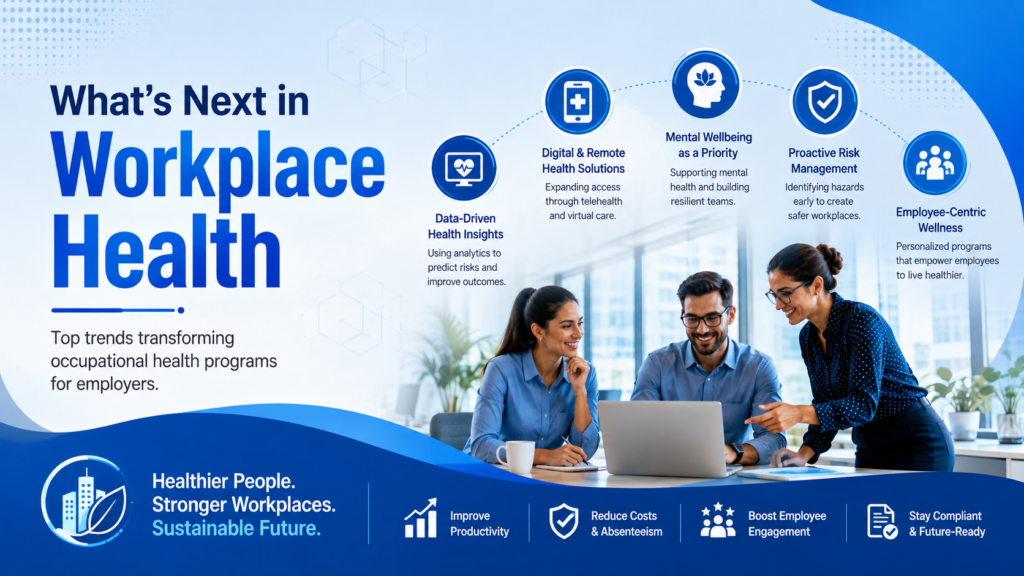
Telehealth is expanding access too. Virtual wellness programs continue to grow, giving employees easy access to consultations, physical therapy, and mental health support from home. This matters most for small businesses and remote teams.
Women’s health is gaining ground as a priority area as well. Employers are expanding support beyond maternity coverage, including menopause programs, fertility benefits, and broader reproductive and maternal health support, often through telehealth access.
Industry trends point toward a broader and more holistic approach to occupational health, with mental and social wellbeing receiving increasing attention alongside physical health and workplace safety. Mental health support is becoming a more important part of how many employers design workplace health programs.
Small businesses may also have more options than in the past. Telehealth and virtual services can reduce some barriers to accessing occupational health support, allowing smaller employers to explore more flexible and scalable service models.
How to Build Effective Occupational Health Programs for Employers To Rely On
Building a strong program takes planning. Here’s a practical approach.
Start with an assessment. Understand your workforce’s specific risks. Office workers face different challenges than factory workers. Tailor your approach accordingly.
- Set clear goals. Are you reducing injury rates? Improving mental health access? Lowering absenteeism? Define success before you start.
- Choose the right mix of services. Combine screenings, mental health support, and chronic disease management. Don’t rely on a single solution.
- Communicate clearly. Employees need to know what’s available. Confusing benefits go unused. Simple, repeated communication drives engagement.
- Measure outcomes. Track participation, absenteeism, and claims data over time. Adjust the program based on what the data shows.
- Partner with experts. Many employers work with specialized providers to run occupational health services efficiently. This reduces internal burden while improving quality.
These steps form the foundation of any successful workplace health program that organizations want to scale across departments and locations.
Corporate Wellness Programs vs. Occupational Health Programs
These two terms often get mixed up. They overlap, but they’re not identical.
Corporate wellness programs typically focus on lifestyle. Think fitness challenges, nutrition coaching, and stress reduction activities. They aim to improve general wellbeing.
Occupational health programs go further. They include medical surveillance, compliance with safety regulations, and address job-specific health risks directly.
The best strategy blends both. Corporate wellness programs build engagement and culture. Occupational health programs protect against real workplace hazards. Together, they create a complete employee health strategy.
Workplace Safety and Health: A Non-Negotiable Foundation
No wellness initiative replaces basic safety. Workplace safety and health standards form the foundation everything else is built on.
This means proper training. It means protective equipment where needed. It means regular audits and clear reporting channels for hazards.
Regulatory requirements and voluntary frameworks such as ISO 45001 continue to encourage more systematic approaches to occupational health and safety. ISO 45001 provides a framework for managing workplace health and safety risks through processes such as hazard identification, risk assessment, monitoring, review, and continual improvement.
Without strong safety fundamentals, other wellness efforts lose credibility. Employees notice quickly when basic safety measures are ignored, and trust is hard to rebuild once it slips. Regular audits, clear hazard reporting, and visible leadership commitment all reinforce that safety is taken seriously, not just stated in a handbook.
The Business Case Is Clear
The data supports investment here. Employers are increasingly rethinking traditional benefits strategies to manage rising healthcare costs while supporting employee wellbeing and engagement. This isn’t a passing trend. It reflects a structural shift in how companies view employee health.
Forward-thinking organizations are not waiting for problems to appear. They’re building occupational health programs they can lean on proactively. They are investing before issues escalate, not after.
This approach protects people, and it protects the bottom line right alongside them. Lower claims, fewer sick days, and stronger retention all tend to follow naturally from solid programs.
Industry-Specific Considerations
Not every workplace faces the same risks. A construction site and a corporate office need very different approaches.
Manufacturing and construction environments need a strong focus on physical hazards. This includes machinery safety, fall prevention, and exposure to chemicals or dust. Routine screenings and on-site clinics work well here.
Office-based and remote workforces face different challenges. Mental health, ergonomics, and chronic stress tend to dominate. Telehealth and virtual counseling fit naturally into these settings.
Healthcare and frontline service workers face elevated burnout risk. Shift work, emotional strain, and physical demands all add up. Programs here often need additional recovery support and flexible scheduling.
Tailoring your approach by industry makes a real difference. The most effective occupational health programs for employers run are never generic; they’re built around actual workforce risk profiles.
Common Mistakes Employers Make
Even well-intentioned programs can fall short. A few mistakes show up again and again.
Treating it as a one-time project. Health programs need ongoing attention, not a single rollout followed by silence.
Ignoring employee feedback. Programs designed without input often miss what people actually need.
Underfunding mental health support. Physical safety gets plenty of attention, while psychological wellbeing is often treated as an afterthought.
Failing to track outcomes. Without data, it’s hard to know what’s working and what isn’t.
Avoiding these pitfalls keeps programs relevant and effective over time.
Measuring Return on Investment
Leadership teams want numbers, not just good intentions. Measuring impact turns a wellness initiative into a budget line that’s easy to defend.
Start with baseline data — current absenteeism rates, injury claims, and healthcare spend — before launching anything new. Without a starting point, improvement is hard to prove later.
Track participation rates closely. A program nobody uses delivers no value, no matter how well it’s designed. Low engagement usually points to poor communication or benefits that don’t match real employee needs.
Watch leading indicators too, not just lagging ones. Survey results on stress, satisfaction, and perceived support can shift months before claims data or turnover numbers move, giving teams a chance to adjust course quickly.
Tie outcomes back to cost where you can. Reduced sick days translate into saved payroll hours. Lower claims translate into smaller insurance premiums over time. Even modest improvements compound across a large workforce, and reporting results regularly keeps leadership engaged and invested.
The Role of Leadership and Culture
No program succeeds without support from the top. Leaders set the tone for whether health initiatives feel genuine or performative.
When executives use mental health days themselves, employees feel permission to do the same. When managers are trained to spot burnout, problems get caught earlier. Culture either reinforces a program or quietly undermines it.
Peer support matters too. Employees often trust colleagues more than HR announcements, so encouraging informal champions across teams can boost participation more than another email campaign ever could.
Small, consistent signals build trust over time — a flexible schedule during a tough week, a manager who checks in without judgment. These moments matter just as much as the formal benefits on paper.
Conclusion
If all of this feels like a lot, that’s a completely normal reaction. Most organizations don’t build a comprehensive program overnight, and they don’t need to.
A good starting point is picking one or two high-impact areas and doing them well, rather than launching everything at once. For many employers, that means starting with mental health access and basic safety compliance, then layering in screenings and chronic disease support as budget allows.
It also helps to involve employees early, even informally. A short survey asking what people actually want often reveals priorities leadership wouldn’t have guessed on their own.
Working with an experienced partner can lighten the load considerably too. Many providers now offer modular services, so you can start small, prove the value internally, and expand in phases as the program earns trust and budget.
Building occupational health programs for employers can genuinely rely on has become an increasingly important part of managing workforce risks, supporting employee wellbeing, and maintaining a competitive workplace. The potential benefits can be significant, particularly when programs are tailored to workforce needs and measured over time.
The good news is that you don’t have to get everything right on day one. Start with the basics: solid safety practices, accessible mental health support, and a plan for chronic disease management. Communicate often, listen to feedback, measure what matters, and keep adjusting as your workforce evolves.
Companies that take this seriously tend to see the same pattern play out: lower costs, higher engagement, and a workforce that feels genuinely supported. That’s a win worth investing in, for your people and for your business alike.
The main goal is preventing workplace illness and injury while supporting employee wellbeing, reducing absenteeism, and improving productivity through proactive health management.
Occupational health programs address job-specific risks and compliance needs, while general wellness programs focus broadly on lifestyle, fitness, and overall employee wellbeing.
Yes. Telehealth and virtual care options have significantly lowered costs, making occupational health services accessible even for small and mid-sized employers today.