

Healthcare professionals are trained to care for others, often at considerable cost to themselves. The same workforce responsible for sustaining patient health is, by many measures, experiencing a sustained mental health crisis of its own. Long shifts, high-stakes decision-making, and constant exposure to suffering have created conditions that few other industries can match, and the data confirms this is not a temporary strain but a structural problem.
Healthcare workers experience substantial levels of burnout and psychological distress, particularly in roles involving long hours, high workloads, and sustained exposure to high-stakes situations. Research has also raised serious concerns about suicide risk among some groups of healthcare professionals. These challenges illustrate a workforce under sustained psychological pressure and reinforce why an EAP for healthcare can form an important component of a broader workforce wellbeing strategy.
This article examines why an EAP for healthcare matters, what an effective program should include, and how healthcare organizations can implement one that genuinely meets the needs of their workforce.
Understanding the Employee Assistance Program
An employee assistance program, or EAP, is a confidential workplace benefit that connects employees with professional support services, typically encompassing mental health counseling, crisis intervention, and referrals for a range of personal and work-related challenges. In most industries, a general EAP framework serves the workforce adequately. Healthcare, however, presents distinct demands that a generic program often fails to address.
Healthcare professionals face unique occupational stressors: exposure to trauma and death, high-pressure decision-making with direct consequences for patient outcomes, irregular and extended shift patterns, and a professional culture that has historically discouraged acknowledging personal struggle. An EAP for healthcare must be designed around these specific realities. It needs to accommodate rotating shifts, provide rapid access during acute crises, and be delivered by professionals who understand the particular pressures of clinical environments, rather than offering generic stress management resources disconnected from the realities of bedside or frontline work.
The Scale of Healthcare Worker Mental Health Challenges
Healthcare worker mental health has reached a level of concern that public health authorities now describe in terms typically reserved for systemic crises. According to data from the CDC, the percentage of health workers reporting frequent burnout rose from 32 percent in 2018 to 46 percent in 2022, alongside a marked increase in reported workplace harassment and a measurable decline in trust toward management during the same period.
The consequences can extend beyond individual wellbeing. Research has identified associations between healthcare worker burnout, medical errors, and patient safety concerns. Healthcare worker mental health is therefore not solely a workforce welfare issue; it can also have wider implications for the quality and safety of care. Organizations should address employee wellbeing as part of a broader approach to both workforce support and patient safety.
The Business and Workforce Case for Healthcare Employee Wellness
Healthcare employee wellness has direct financial implications that extend well beyond the cost of any wellness program itself. Physician turnover alone is estimated to cost healthcare organizations between 500,000 and 1 million dollars per departing doctor, accounting for recruitment, onboarding, and lost productivity during the transition period. Broader workforce attrition compounds this further. Approximately 20 percent of the U.S. healthcare workforce left their positions between early 2020 and late 2021, and a substantial share of remaining healthcare workers have indicated intentions to leave their roles in the years that followed.
Investing in healthcare employee wellness can form part of a broader response to retention challenges. An EAP for healthcare provides employees with an accessible source of confidential support during periods of stress or personal difficulty. When combined with efforts to address workload, staffing, workplace culture, and other structural pressures, an EAP may also support workforce wellbeing and stability.
Workplace Wellbeing in Healthcare: A Systemic Challenge
Workplace wellbeing in healthcare cannot be addressed through individual coping strategies alone, though these remain useful. The underlying drivers of poor wellbeing in this sector are largely structural: excessive administrative burden, inadequate staffing ratios, and a documentation load that consumes a disproportionate share of clinical time. Research has found that administrative burden accounts for nearly a quarter of the variation in physician burnout scores, and that physicians spend roughly two hours on electronic health record tasks for every hour spent in direct patient care.
These systemic pressures mean that workplace wellbeing in healthcare requires organizational-level intervention, not solely individual support. An EAP for healthcare plays an important role within this broader effort, providing employees with a confidential outlet to manage the psychological toll of these conditions while organizations work toward addressing root causes such as staffing levels and administrative workload. Workplace wellbeing in healthcare improves most meaningfully when individual support and structural reform progress together, rather than treating one as a substitute for the other.
How Employee Wellness Programs Must Adapt for Clinical Settings
Most employee wellness programs target standard office environments, where employees typically work predictable hours and have consistent access to digital communication throughout the day. Healthcare settings rarely match this profile. Clinical staff often work twelve-hour shifts, rotate between day and night schedules, and have limited capacity to step away during active patient care.
To function effectively in this environment, employee wellness programs require substantial adaptation. Counseling access needs to extend across all shift patterns, including nights and weekends, rather than operating solely during conventional business hours.
Crisis support must be immediately accessible, given the acute, high-stakes nature of many healthcare workplace stressors, such as patient deaths, medical errors, or workplace violence. Confidentiality plays a particularly important role in clinical settings, as licensing and professional credentialing requirements can raise concerns about disclosure, even when those concerns may not always apply.
An EAP for healthcare can provide employees with access to support during periods of acute stress, burnout, or personal difficulty. As part of a broader workforce wellbeing strategy, it may help organizations respond more consistently to employee support needs. Its impact on turnover, patient outcomes, and other business measures will vary depending on workplace conditions, program design, employee needs, and the broader actions an organization takes to address structural sources of stress.
Corporate Wellness Programs Versus a Healthcare-Specific EAP
Many healthcare organizations already maintain some form of corporate wellness programs, often encompassing general health screenings, fitness incentives, or wellness newsletters. While these corporate wellness programs offer general value, most do not specifically address the psychological demands of clinical work.
Standard corporate wellness programs typically assume stressors related to deadlines, workload management, and interpersonal workplace dynamics. Healthcare professionals contend with a fundamentally different category of stress, including moral injury arising from systemic constraints on patient care, secondary trauma from repeated exposure to suffering and death, and the psychological weight of high-stakes clinical decisions made under significant time pressure. A generic program built around conventional workplace stress is unlikely to adequately address these realities.
For this reason, healthcare organizations should use an EAP as a specialized, clinically informed complement to broader corporate wellness programs. A healthcare-focused EAP can address the specific psychological demands of clinical work that general wellness initiatives may not fully address.
Core Components of an Effective EAP for Healthcare
An effective EAP for healthcare typically includes several defining elements.
Round-the-clock crisis access is essential, given the unpredictable and often acute nature of healthcare workplace stressors, including critical incidents, patient deaths, and exposure to workplace violence.
Counselors with clinical healthcare experience or specialized training in healthcare-related trauma provide more relevant support than general practitioners unfamiliar with the realities of clinical environments.
Confidentiality protections that explicitly address licensing and credentialing concerns help reduce hesitation among healthcare professionals who may otherwise avoid seeking support out of fear that doing so could affect their professional standing.
Peer support integration, allowing colleagues trained in psychological first aid to provide initial support following critical incidents, complements formal counseling and reflects evidence-based approaches increasingly adopted within healthcare systems.
Leadership and management training equips supervisors to recognize signs of burnout and distress among staff and to facilitate access to support without stigma or professional consequence.
Combined, these elements position an EAP for healthcare as a substantive, clinically relevant resource rather than a generic benefit poorly matched to the realities of frontline healthcare work.
The Strategic Case for Investing in an EAP for Healthcare
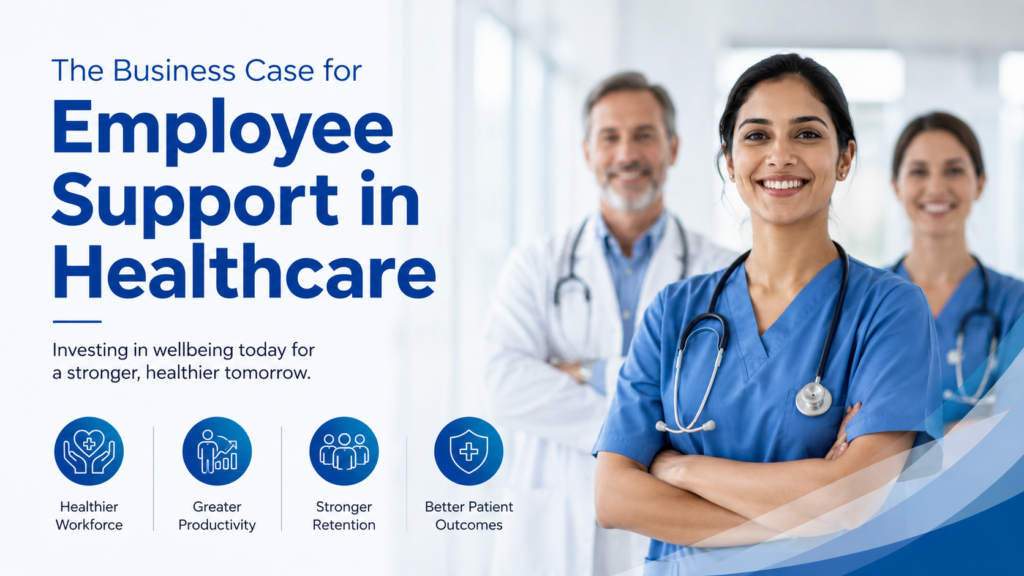
Some healthcare organizations continue to regard an EAP for healthcare as a discretionary expense rather than a strategic investment. The available evidence strongly suggests otherwise. Physician turnover can create substantial recruitment, onboarding, and productivity costs. Healthcare worker burnout can also contribute to medical errors and patient safety concerns. These factors make a strong case for proactive investment in workforce mental health and wellbeing.
An EAP for healthcare can provide employees with access to support during periods of acute stress, burnout, or personal difficulty. As part of a broader workforce wellbeing strategy, it may help organizations respond more consistently to employee support needs. Its impact on turnover, patient outcomes, and other business measures will vary depending on workplace conditions, program design, employee needs, and the broader actions an organization takes to address structural sources of stress.
Implementing an EAP for Healthcare
Implementing an EAP for healthcare effectively requires attention to the specific operational realities of clinical environments. Organizations should begin with an anonymous workforce assessment to understand the specific stressors affecting their staff, recognizing that these may differ meaningfully across departments, shift patterns, and roles.
From there, organizations should select a provider with demonstrated experience supporting healthcare workforces specifically, rather than a general EAP vendor unfamiliar with clinical environments. Providers should offer genuine around-the-clock access, given the unpredictable nature of acute incidents in healthcare settings, along with explicit confidentiality assurances addressing licensing-related concerns.
Clear, consistent communication is critical to program adoption. Many healthcare professionals, conditioned by a culture that has historically discouraged acknowledging personal struggle, will not engage with a program they do not fully trust. Leadership should introduce the EAP for healthcare through direct communication that explicitly affirms confidentiality and reassures staff that seeking support carries no professional consequence.
Finally, organizations should track aggregate utilization trends over time, rather than individual cases, to assess program effectiveness and refine offerings based on the evolving needs of their workforce.
Conclusion
Healthcare work demands extraordinary resilience, but resilience alone cannot offset the structural and emotional toll of sustained exposure to high-stakes, high-pressure clinical environments. The evidence is unambiguous: burnout, moral injury, and mental health challenges are widespread among healthcare professionals, with direct consequences for both workforce stability and patient safety.
An EAP for healthcare provides a structured, professionally delivered response to this reality. It addresses healthcare worker mental health directly, strengthens healthcare employee wellness, and supports genuine workplace wellbeing in healthcare rather than treating these as secondary concerns. When organizations integrate an EAP within broader employee wellness and corporate wellness programs, they provide the people responsible for patient care with the same structured, accessible support they are trained to provide to others.
Healthcare organizations that invest in meaningful workforce support demonstrate a commitment to the wellbeing of the people responsible for patient care. An EAP can form one part of a broader strategy that supports healthcare professionals while organizations continue to address workload, staffing, workplace culture, and other structural sources of stress. The need for accessible employee support is well documented, and healthcare organizations should ensure that their wellbeing strategies reflect the realities of clinical work.
Frequently Asked Questions
EAP services are generally designed to provide confidential support, and personal information is handled according to the provider’s privacy policies, applicable laws, and the terms of the program. Healthcare professionals should review how confidentiality and reporting arrangements apply to their specific EAP, employer, and professional requirements.
Healthcare worker burnout and psychological distress have been associated with medical errors and patient safety concerns. An EAP can provide confidential support for employees, while broader organizational efforts to address workload, staffing, and workplace conditions remain important for supporting both staff wellbeing and safe clinical care.
Yes, effective programs offer around-the-clock access, accommodating night shifts, weekend rotations, and the unpredictable timing of acute clinical incidents.