

The hospitality industry is sustained by its people. Every seamless guest experience, every efficiently managed event, and every standard of service that defines a brand’s reputation rests on the capability and wellbeing of the workforce delivering it. Yet the same industry that demands consistent excellence from its staff has, by measurable evidence, underinvested in the support structures those staff require to sustain it.
The consequences of this gap are well documented. The 2025 Taking the Temperature survey, conducted by Hospitality Action, found that nearly half of respondents described burnout as simply part of the job, a figure rising to 62 percent among junior employees.
Three-quarters reported having faced mental health struggles in their adult lives, with nearly one in three experiencing difficulties in the preceding year alone. Guest-facing roles, including servers, receptionists, and baristas, are particularly affected, with workers in these positions nearly twice as likely to experience depression and one-third more likely to suffer from anxiety compared to employees in other industries.
These figures describe a workforce under sustained, structural strain. An EAP for hospitality offers a professionally delivered, evidence-based response to this challenge – one that the industry can no longer reasonably treat as a discretionary benefit.
Understanding the Employee Assistance Program
An employee assistance program, or EAP, is a confidential workplace benefit connecting employees with professional support services. These typically encompass mental health counseling, crisis intervention, financial guidance, and referrals for a range of personal and professional challenges. In industries operating within conventional office environments, a general EAP framework tends to serve the workforce adequately. Hospitality presents a fundamentally different set of conditions.
Staff across this sector work evenings, weekends, and public holidays as a matter of routine. Many are employed on variable-hours or seasonal contracts with limited income predictability. The emotional labor inherent in guest-facing work is continuous, and the pace of service environments rarely permits reflection or recovery during a shift. An EAP for hospitality must be designed around these operational realities from the outset, rather than applying a corporate framework that assumes stable schedules and consistent workplace environments.
The State of Hospitality Mental Health
Hospitality mental health challenges are pervasive, yet they have historically received insufficient formal attention within workforce strategy. Forty percent of hospitality employees report that their work negatively affects their mental health, while 54 percent indicate their organization does not provide adequate training on mental health and wellbeing, and 38 percent report feeling unprepared to manage high-stress situations when they arise.
The structural causes of these figures are equally well evidenced. The 2025 Taking the Temperature survey identified under-resourcing and understaffing as the primary workplace challenge, cited by 57 percent of respondents, representing a 21 percent increase from the prior year. High expectations and excessive workloads followed at 52 percent, with work-life balance concerns raised by 50 percent of respondents, reinforcing that conditions across the sector have deteriorated rather than stabilized.
Hospitality workers can experience significant levels of stress, burnout, and mental health challenges, particularly in roles involving irregular schedules, high workloads, and sustained customer-facing demands. These pressures can leave employees feeling isolated and make it more difficult to maintain a healthy balance between their professional and personal lives. Addressing hospitality mental health in a meaningful way requires more than awareness initiatives. It requires accessible, professional support delivered in a format suited to how hospitality professionals actually work.
The Operational Cost of Inadequate Hospitality Employee Wellness
Hospitality employee wellness carries direct and quantifiable implications for organizational performance. The hospitality industry averages an annual staff turnover rate of 74 percent, substantially above the 12 to 15 percent observed across most other industries, with hotels reporting turnover rates as high as 105 percent. Among surveyed U.S. front-line managers, 64 percent reported that staff had left their roles specifically due to burnout, while 68 percent indicated that team members had actively expressed burnout to them.
The financial consequences of this attrition are considerable. Recruiting, onboarding, and training replacement staff absorb resources that would otherwise support service quality and organizational development. Only approximately 33 percent of hospitality workers report feeling engaged with their roles, a rate materially lower than the general workforce average. Improving hospitality employee wellness through structured, accessible professional support can form part of a broader response to disengagement and burnout. Its impact on staff retention will vary depending on working conditions, pay, staffing levels, workplace culture, and other factors that influence employee decisions.
Workplace Well-Being as an Operational Imperative
Hospitality organizations increasingly recognize workplace well-being as a core operational priority rather than a supplementary benefit. Mental health is now cited as the third most common reason for absence from work in the hospitality sector. Among employees reporting poor work-life balance and daily burnout, 61 percent experienced a mental health issue in the preceding year.
The organizational effects can extend beyond individual staff members. Sustained stress and burnout may affect employee engagement, concentration, and consistency at work, which can influence service quality and the guest experience. Workplace wellbeing should therefore form part of a broader approach to supporting both employees and operational performance.
The 2025 survey data highlights the importance of responding to mental health and wellbeing challenges within the hospitality sector. Organizations can make workplace wellbeing a more consistent strategic priority by combining accessible employee support with broader efforts to address staffing pressures, workloads, scheduling, and workplace culture. An EAP for hospitality can form one part of this wider approach.
How Employee Wellness Programs Must Be Adapted for Hospitality
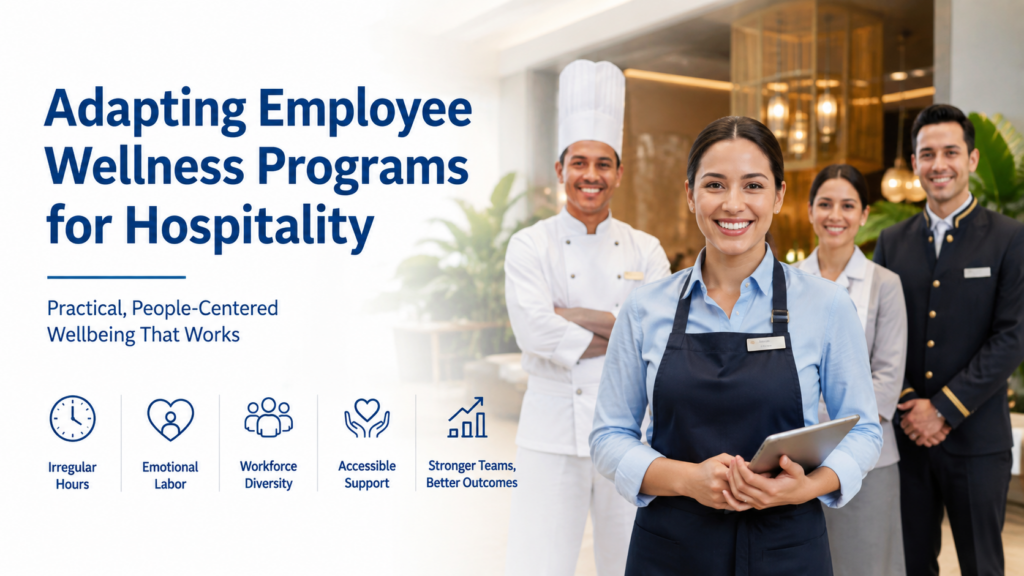
Most employee wellness programs assume that employees work predictable schedules and operate within fixed workplace environments.Hospitality operates under fundamentally different conditions. Staff rotate across shifts, frequently work split hours, and rarely have access to quiet time or private space during a working day. Many do not have regular access to a desktop computer or a fixed workplace station.
Effective employee wellness programs for this sector require deliberate adaptation. Support must be available outside standard business hours, accessible via mobile devices, and straightforward to engage with rapidly rather than requiring advance scheduling or extended administrative processes. Many hotel, restaurant, and events workforces include employees from diverse linguistic backgrounds, so organizations should make language accessibility a priority when designing employee support programs.
An EAP for hospitality that genuinely functions as one of the most accessible employee wellness programs a business offers – one designed around shift patterns and operational realities rather than a conventional office calendar – represents a fundamentally different proposition from a general wellness benefit applied without adaptation.
Corporate Wellness Programs Versus a Sector-Specific EAP
Many hospitality organizations already maintain some form of corporate wellness programs, encompassing general health benefits, fitness incentives, or periodic wellbeing communications. These corporate wellness programs carry value but were not designed to address the specific psychological demands of hospitality work.
Hospitality employees face occupational stressors that differ from those addressed by most corporate wellness programs. These challenges include managing volatile guest interactions, handling the emotional demands of service delivery under pressure, working through extended peak seasons with reduced staffing, and managing income variability in tipped or casual roles. Research indicates that 69 percent of shift workers report feeling exhausted due to their working schedules, while 76 percent of managers across the sector experience burnout – figures that underscore the limitations of generic wellness frameworks when applied to this environment.
An EAP for hospitality functions most effectively as a focused, clinically informed complement to existing corporate wellness programs, addressing the sector-specific pressures that a general wellness initiative does not adequately reach.
Core Components of an Effective EAP for Hospitality
A well-designed EAP for hospitality incorporates several defining elements, each addressing a dimension of the occupational experience unique to this industry.
Confidential counseling available around the clock is a foundational requirement, ensuring that support remains accessible regardless of shift patterns and removing scheduling barriers that may prevent hospitality workers from seeking help during conventional hours.
Crisis support for acute incidents, including workplace aggression, customer hostility, and high-pressure service failures, addresses the specific acute stressors that arise regularly in guest-facing environments and that standard counseling referrals are often too slow to address effectively.
Manager and supervisory training helps leaders recognize early signs of burnout and psychological distress within their teams and guide employees toward appropriate support without stigma, particularly in workplace cultures where people have historically felt discouraged from acknowledging their struggles.
Financial and legal guidance addresses a dimension of stress particularly relevant to hospitality workers in tipped, variable-hours, or seasonally employed roles, where income unpredictability is a persistent source of anxiety.
Multilingual access reflects the demographic reality of many hospitality workforces and ensures that the program is genuinely accessible to all staff rather than accessible in principle but limited in practice.
Collectively, these components establish an EAP for hospitality as a substantive, operationally informed resource rather than a benefit that exists on paper but fails to reach the staff who need it most.
The Business Case for Investment
From an organizational perspective, burnout, absenteeism, turnover, and disengagement can create significant operational and financial challenges. An EAP for hospitality can provide employees with access to confidential support during periods of stress or personal difficulty, while organizations continue to address broader workplace conditions that may contribute to these challenges.
Accessible mental health support can form an important part of a broader employee wellbeing strategy. An EAP for hospitality provides employees with a confidential source of professional support and can help organizations respond more consistently to employee wellbeing needs. Its impact on burnout, staff retention, recruitment costs, and other business outcomes will vary depending on program design, employee needs, workplace conditions, and the broader actions an organization takes to address structural sources of stress.
Implementation Considerations
Introducing an EAP for hospitality effectively begins with understanding what the workforce actually needs. An anonymous staff survey identifying the most significant sources of stress, whether understaffing, customer aggression, financial pressure, or schedule unpredictability, provides a more reliable foundation for program design than a generic assessment.
From there, organizations should choose an EAP provider with demonstrated experience supporting shift-based, service industry workforces and ensure the provider has adapted its services to the realities of the hospitality environment. Program communication should be clear, direct, and delivered through channels that reach all staff, not only those with regular access to organizational email or internal systems. Leadership should clearly explain how confidentiality works and how providers handle personal information according to their privacy policies, applicable laws, and program terms. Organizations should also explain how participation information is protected and clarify the reporting arrangements that apply to the program.
Sustained engagement, rather than a one-time launch, determines whether an EAP for hospitality becomes an embedded organizational resource or a benefit that fades from staff awareness within months of introduction.
Conclusion
The hospitality industry depends entirely on its people, and yet the data is unambiguous: those people are experiencing burnout, mental health difficulties, and inadequate support at rates that exceed most comparable industries. The conditions driving these outcomes have not improved in recent years – in several respects, they have worsened.
An EAP for hospitality can provide a practical source of confidential, professional support for employees experiencing stress, burnout, or personal difficulties. As part of a broader employee wellbeing strategy, it can support hospitality employee wellness and help organizations make workplace mental health a more consistent priority. Organizations should combine EAP support with broader efforts to address staffing, workloads, scheduling, and workplace culture.
Organizations that invest in meaningful employee support demonstrate a commitment to the wellbeing of their workforce. An EAP can form one part of a broader strategy that supports employees while organizations continue to address the operational and workplace conditions that shape both employee wellbeing and long-term organizational performance.
Frequently Asked Questions
Irregular hours, high emotional labor, chronic understaffing, and a workplace culture that normalizes stress create challenges that generic wellness programs may not adequately address.
An EAP for hospitality can provide employees with confidential support during periods of stress or personal difficulty. While its effect on staff turnover will vary, it can form part of a broader employee wellbeing strategy alongside efforts to address pay, workloads, staffing, scheduling, and workplace culture.
Yes. Effective programs provide around-the-clock access via telephone and digital channels, accommodating the evening, weekend, and irregular shift patterns standard across the hospitality sector.