

Remote work has created greater flexibility for many employees, but it has also introduced new challenges around isolation, blurred boundaries, and sustained digital connectivity.
Without regular in-person interaction, remote employees may have fewer opportunities for informal conversations, spontaneous check-ins, and visible signs that a colleague may need additional support. These differences can make it important for organizations to consider how employees can access wellbeing resources in a distributed work environment.
An EAP for remote companies can provide accessible professional support through digital channels. This guide explores why remote teams may benefit from an EAP, what to look for in a virtual program, and how to implement one that fits a distributed workforce.
What Is an EAP for Remote Companies?
An employee assistance program is an employer-sponsored benefit that can provide confidential access to professional support for personal and work-related challenges. Available services may include counseling, financial guidance, legal consultations, crisis support, and other resources, depending on the provider and program.
For remote companies, the delivery model can be as important as the services themselves. Programs that rely heavily on in-person appointments or office-based referrals may not provide the same level of accessibility for a distributed workforce.
A virtual employee assistance program can deliver available services through digital channels such as video counseling, phone support, text-based services, mobile apps, and online self-help tools. The services, availability, and geographic coverage will vary according to the provider and program design.
The Remote Work Mental Health Crisis Employers Cannot Afford to Ignore
Remote work mental health challenges are not simply an extension of general workforce stress. They are structurally unique – and they require structurally specific solutions.
Loneliness and Disconnection
Remote employees may experience periods of isolation or disconnection, particularly when their work involves limited informal interaction with colleagues. Digital communication can support collaboration, but it may not fully replicate the social connections that develop through regular in-person contact.
Organizations should consider how their employee wellbeing strategies address both work-related pressures and the social challenges that some employees may experience while working remotely.
The Always-On Problem
Remote work can make it difficult for some employees to establish clear boundaries between professional and personal time. When work takes place in the same environment as home life, employees may find it harder to disconnect from messages, meetings, and ongoing responsibilities.
Over time, limited opportunities for rest and recovery can affect employee wellbeing. Organizations can support healthier working patterns by combining appropriate workplace practices with accessible resources for employees who need additional support.
Burnout Without a Visible Signal
Remote work can make it more difficult for managers and colleagues to recognize changes in an employee’s wellbeing. In a physical workplace, teams may notice changes in behavior or engagement through regular interaction, while distributed teams often rely primarily on scheduled meetings and digital communication.
An EAP for remote companies can provide employees with confidential access to professional support without requiring managers to identify every potential concern.
Why a Standard EAP Is Not Enough for Remote Teams
Most traditional EAPs were built for office-based workforces. They assume employees can walk to an on-site wellness room, meet a counselor in a local clinic, or pick up a flyer from the break room.
These assumptions may not align with the realities of a distributed workforce, where employees often need to access support remotely.
Remote employees may need access to support that reflects the realities of distributed work. They may work across different time zones, live in other countries, share their homes with family members and have limited privacy for sensitive conversations, or live in areas with limited access to local mental health providers.
A virtual employee assistance program can help address some of these access challenges by offering support through digital channels and flexible service options. Depending on the provider and program design, organizations may consider:
- Virtual access to available services
- Support across different schedules and time zones
- Video, phone, text, or app-based options where available
- Multilingual support for diverse workforces
- Flexible access options for employees with limited privacy
- Privacy and data protection practices appropriate to the provider, program, and applicable regulations
Organizations can consider how the technology and communication channels used for remote work may also help employees access wellbeing resources and professional support.
Core Components of an EAP Built for Remote Companies
An effective EAP for remote companies should reflect the realities of a distributed workforce rather than simply adapting an office-based program for digital use. The right combination of accessible services, flexible delivery options, and appropriate professional support can help employees access resources regardless of where they work.
1. Virtual Mental Health Counseling
Virtual mental health counseling can form an important part of an EAP for remote companies. Organizations should evaluate whether employees can access counseling through appropriate digital channels, the availability of qualified professionals, the number of sessions included, and the provider’s process for connecting employees with additional care when needed.
Counselors should be available to support remote work mental health challenges specifically – including burnout, isolation, boundary-setting, and the anxiety of working without clear separation between home and professional life.
2. 24/7 Crisis Support
Mental health crises do not follow business hours. Remote employees working across time zones – or those experiencing acute distress outside of 9-to-5 – need access to real human support at any time. Organizations should evaluate whether an EAP provider offers appropriate crisis support arrangements and whether employees can access relevant services outside standard working hours when needed.
3. Financial and Legal Counseling
Economic uncertainty amplifies mental health challenges. Financial stress is one of the most significant drivers of workplace anxiety and reduced performance. Financial and legal guidance may provide additional practical support for remote employees dealing with personal financial concerns, contractor arrangements, tax questions, or other issues relevant to their circumstances.
4. Manager Training and Consultation
Remote managers face the added challenge of supporting employees without the regular in-person interactions that can provide additional context about their wellbeing. They may find it harder to recognize changes in an employee’s engagement, conduct supportive check-ins through digital channels, or determine when it may be appropriate to direct someone toward available support.
Organizations may also consider EAP programs that provide resources, consultation, or training for managers. These services can help leaders develop supportive communication practices and understand how to direct employees toward available resources without pressure or stigma.
5. Digital Wellness Tools and Self-Guided Resources
Between-session support matters for remote employee wellness. Digital tools can extend EAP support beyond counseling sessions. They may include mindfulness exercises, mood tracking, sleep support, resilience resources, and burnout prevention tools.
Employees who do not need formal counseling may still benefit from self-guided resources. They can access these resources privately and at their own pace. These tools can complement other forms of professional and workplace support.
6. Global and Multilingual Capability
A remote company may have employees across five continents. An EAP that only serves English-speaking employees in one country is not an EAP for a remote company. It is a partial benefit. Look for providers with multilingual counselor networks and culturally appropriate care options. Organizations with international employees should review the provider’s privacy and regulatory requirements. They should also check whether the provider can meet applicable requirements in the countries where employees work.
Benefits of an EAP for Remote Companies
An EAP can provide remote employees with confidential professional support for personal and work-related challenges. When combined with broader workplace practices that address workload, communication, and employee wellbeing, a virtual EAP can make support more accessible across a distributed workforce.
- Accessible Professional Support – Employees can access counseling and other professional resources remotely. They do not need to visit a physical workplace or provider location.
- Support for Remote Work Challenges – Employees can access support for stress, isolation, boundary challenges, and other work-related pressures.
- Flexible Access Options – Services may be available through video, phone, text, or other digital channels. Availability depends on the provider and program.
- Support Across Distributed Teams – Organizations can choose services that meet the geographic, language, and scheduling needs of their workforce.
- Financial and Legal Resources – Some EAPs offer financial guidance, legal consultations, or referrals. These services can help employees manage practical personal concerns.
- Resources for Managers – Manager consultation, coaching, or training can help leaders understand available resources. It can also support more effective wellbeing conversations.
- Self-Guided Wellbeing Tools – Digital resources give employees additional support options. They can explore wellbeing topics privately and at their own pace.
How to Choose the Right Virtual EAP for Remote Companies
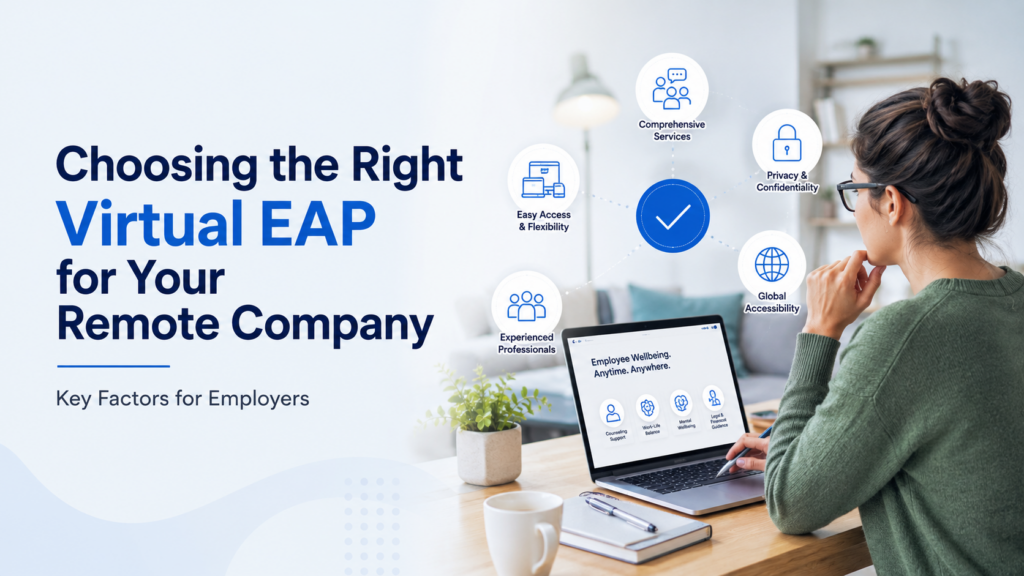
The right virtual EAP should make professional support accessible to employees regardless of where they work. Organizations should evaluate each provider’s services, digital access options, workforce coverage, and ability to meet their specific needs.
Access model: Does the EAP deliver all services virtually? Can employees access support via video, phone, text, and app? Is support available 24/7? For predominantly remote teams, organizations should consider whether the provider offers sufficient virtual access to the core services employees are most likely to need.
- Access and response arrangements: Ask providers how employees access counseling, typical response times for non-crisis support, and what crisis support arrangements are available. Organizations should evaluate whether these processes meet the needs of their workforce.
- Global capability: Organizations with international employees should evaluate whether the provider can serve relevant locations, offer appropriate language support, and meet applicable privacy, data protection, and regulatory requirements.
- Counseling availability: Review the number of counseling sessions included, the process for accessing additional care, and whether the provider’s service model aligns with the needs of the workforce.
- Manager resources: Does the program include specific resources, coaching, and training for remote managers? Leaders of distributed teams need dedicated support – not just access to the same resources as individual contributors.
- Digital tools and proactive content: Does the EAP offer on-demand wellness tools, resilience programs, and self-guided mental health resources? Proactive resources can give employees opportunities to explore wellbeing support before they decide they need formal professional assistance.
- Reporting and analytics: Can you track aggregate utilization rates, presenting concerns, and engagement trends without compromising individual privacy? Data helps you refine the program and build the internal case for continued investment.
Implementing an EAP at Your Remote Company
For remote companies, implementing an EAP involves creating a practical connection between the provider’s services and the day-to-day realities of a distributed workforce. Organizations should consider communication, accessibility, manager guidance, and ongoing program review as part of the implementation process.
- Start with a team needs assessment. Survey employees anonymously about their primary stressors – isolation, workload, boundary challenges, financial pressure, or access to care. Use this data to match your EAP vendor selection to actual workforce needs.
- Communicate consistently, not just during onboarding. Remote employees may have fewer opportunities to encounter informal reminders about workplace benefits. Organizations can communicate the EAP through digital onboarding, team meetings, internal communication platforms, newsletters, and other appropriate channels throughout the year.
- Provide managers with appropriate guidance. Managers may notice changes in communication, engagement, or work patterns, but they should not be expected to diagnose mental health concerns. Training can help managers conduct supportive conversations and direct employees toward available resources when appropriate.
- Build a culture that normalizes support. Some employees may hesitate to discuss mental health concerns or seek professional support. Organizations can help reduce stigma by communicating that wellbeing resources are available and by encouraging respectful, supportive workplace conversations while protecting individual privacy.
- Offer the EAP to family members. Remote work can blur the boundary between professional and personal life. Personal and family challenges may also affect an employee’s overall wellbeing and ability to manage work-related demands. Many EAPs extend services to employees’ household members. For a distributed workforce where home is the office, this coverage is especially valuable.
- Review the program regularly. Organizations can review aggregate utilization information, employee feedback where appropriate, available service data, and workforce needs to assess whether the EAP continues to meet its objectives.
Conclusion
An EAP for remote companies can provide employees with access to counseling, crisis support, financial guidance, and other professional resources through delivery models suited to distributed work.
The value of an EAP will depend on workforce needs, program design, employee awareness, access to services, and the broader workplace environment. Organizations can consider it as one part of a wider strategy that supports remote employee wellbeing alongside effective management, communication, workload practices, and workplace culture.
For distributed organizations, a virtual EAP can help make professional support more accessible to employees regardless of where they work.
Frequently Asked Questions (FAQs)
Organizations can increase awareness of an EAP through consistent communication across multiple channels, including digital onboarding, team meetings, internal communication platforms, and regular employee communications. Clear information about how to access services, what support is available, and how confidentiality works can also help employees understand and consider using the program.
A virtual EAP may be able to serve employees in multiple countries, depending on the provider’s geographic coverage, professional network, language capabilities, and compliance arrangements. Organizations should review whether the provider can appropriately support employees in the locations where they operate.
A strong EAP for remote companies addresses the structural mental health challenges of distributed work: counseling for isolation and loneliness, burnout support for employees struggling to disconnect, boundary-setting coaching, financial and legal guidance for remote-specific stressors, and self-guided digital wellness tools for between-session support. These services can complement the workplace communication and support systems that organizations develop for distributed teams.