

Construction has long been recognized as one of the most physically demanding industries, yet its psychological demands are often overlooked. Long working hours, demanding project deadlines, physically strenuous tasks, and the pressure to maintain strict safety standards create a work environment where chronic stress can become a daily reality. Combined with job insecurity, time away from family, and ongoing physical pain, these challenges place construction workers at a significantly higher risk of mental health concerns.
The evidence is difficult to ignore. According to U.S. data from the Centers for Disease Control and Prevention (CDC), construction and extraction workers are among the occupational groups with the highest suicide rates in the United States. Research also shows that anxiety, depression, and work-related stress are widespread across the industry, with many workers reporting that these challenges affect both their professional performance and personal wellbeing. Despite these realities, many construction companies still lack structured mental health resources capable of addressing the unique pressures their workforce faces.
This is where an (Employee Assistance Program) EAP for construction becomes essential. More than a workplace benefit, an EAP provides confidential access to mental health counseling, crisis intervention, financial and legal guidance, substance use support, and other wellbeing resources tailored to the realities of construction work. By supporting employees before stress develops into burnout, absenteeism, or safety incidents, an effective EAP strengthens both workforce wellbeing and organizational performance.
In this guide, we’ll explore why an EAP for construction has become a critical investment, the key components of an effective program, and how construction companies can successfully implement one to improve employee wellbeing, retention, and jobsite safety.
What Is an Employee Assistance Program?
An employee assistance program, or EAP, is a workplace benefit that gives employees confidential access to support services – typically mental health counseling, financial guidance, legal advice, and substance abuse support.
For office-based industries, EAPs have existed for decades and work reasonably well as-is. Construction is different, though. Workers are spread across job sites, schedules shift constantly, and the stigma around mental health runs deep. A generic, off-the-shelf EAP often misses the mark here.
That’s why an EAP for construction needs to be built differently – mobile-friendly, available after hours, and shaped around the actual rhythms of fieldwork. It also needs to speak the language of construction culture, where toughness is often prized over vulnerability, instead of feeling like a corporate add-on bolted onto a job site.
Why Mental Health in Construction Deserves More Attention
Mental health in construction has been overlooked for a long time. The industry pours resources into physical safety – hard hats, harnesses, fall protection – and rightly so. But mental health in construction deserves the same level of seriousness, even though it gets a fraction of the conversation.
Workers in this field often deal with chronic pain, disrupted sleep, and the financial stress that comes with seasonal or project-based work. Add in long stretches away from family, and you get a workforce under near-constant strain. Many don’t seek help, either out of fear of judgment from coworkers or worry that it could put their job at risk.
That silence can have real consequences. Stress and poor mental health may affect concentration, decision-making, and work performance, which can create additional challenges in an already high-risk work environment. Mental health in construction cannot remain a side conversation, and an EAP for construction can provide workers with an accessible source of support when they need it.
The Case for Construction Employee Wellness
Construction employee wellness means more than yoga mats and gym memberships. It means giving workers real, usable tools to manage stress, anxiety, and the personal challenges that follow them onto the job site. At its core, it means making sure no one feels like they’re carrying it alone.
When companies invest in construction employee wellness, they can create conditions that support attendance, focus, and overall workforce wellbeing. The results will vary depending on the program, workforce needs, and how consistently the organization implements and promotes available support.
An EAP for construction is one of the most direct ways to deliver construction employee wellness at scale, since it reaches every employee regardless of role or seniority. From laborers to project managers, everyone gets access to the same baseline of care.
Building a Culture of Construction Workplace Wellbeing
Construction workplace wellbeing isn’t just about having a program in place – it’s about culture, and culture starts with leadership. If supervisors treat mental health as a weakness, workers learn to hide their struggles. If leaders openly support wellbeing instead, workers feel safer asking for help when they need it.
A well-run EAP for construction supports exactly this kind of culture shift. It gives supervisors training to recognize warning signs, and it gives workers a confidential way to reach out without fear of judgment. Over time, that consistency builds trust, and construction workplace wellbeing becomes part of how the company actually operates, not just something mentioned in an orientation packet.
Companies that take construction workplace wellbeing seriously also tend to retain workers longer. Skilled tradespeople are hard to find and even harder to keep, and a strong wellness program sends a clear signal that a company values its people, not just their output.
Most employee wellness programs are built with desk jobs in mind. They assume regular hours, a fixed location, and reliable internet access – none of which describe construction work.
To actually work in this industry, employee wellness programs need flexibility built in from the start. Counseling should be available by phone, text, or video, not just in scheduled in-person appointments. Services need to run outside standard business hours, since many crews start before sunrise. Language access matters too, given how diverse construction workforces tend to be.
An EAP for construction should aim to be one of the most accessible employee wellness programs a company offers, removing barriers instead of adding them. The easier it is to use, the more likely workers are to actually engage with it.
Corporate Wellness Programs vs. Industry-Specific EAPs
Plenty of companies already offer corporate wellness programs – health screenings, gym discounts, the occasional wellness newsletter. These have their place, but they rarely touch the specific pressures of construction work.
Most corporate wellness programs are designed around a stable office environment. Construction workers face a different set of risks: physical injury, job site stress, and unpredictable schedules that don’t map onto a typical nine-to-five framework. A one-size-fits-all approach tends to miss these realities entirely.
That’s why an EAP for construction works best as a specialized extension of broader corporate wellness programs, rather than a replacement for them. It fills the gaps a general program leaves open, speaking directly to the daily experience of fieldwork instead of assuming a desk-based routine.
Core Components of an Effective EAP for Construction
A strong EAP for construction tends to share a few key ingredients.
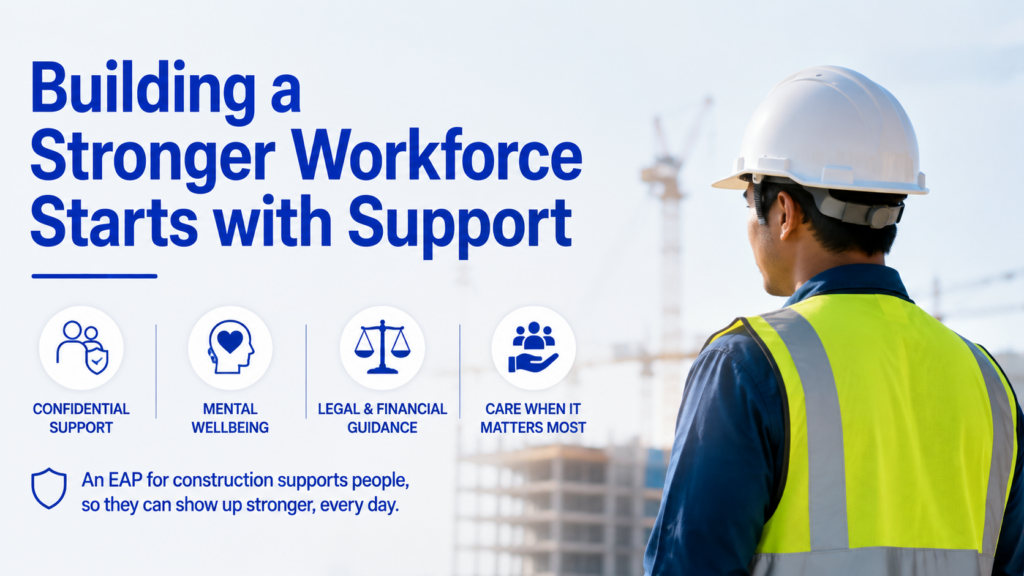
- Confidential counseling comes first. Workers need a safe space to talk through stress, anxiety, depression, or substance use, and that confidentiality is what builds the trust needed for people to actually use the service.
- Round-the-clock crisis support matters too, since accidents and personal crises don’t wait for business hours. Immediate access to a counselor can make a real difference in those high-risk moments.
- Financial and legal guidance rounds things out further. Many construction workers face real financial stress from seasonal layoffs or gaps between projects, and practical support here can ease a major source of anxiety.
- Manager training is just as important as any of the above. Supervisors should know how to recognize signs of distress and how to point workers toward support without making them feel judged.
- And multilingual access shouldn’t be an afterthought, given how diverse construction crews usually are.
Put these pieces together, and an EAP for construction becomes more than a compliance checkbox – it becomes a real safety net for the workforce.
The Business Case: Why an EAP for Construction Pays Off
Some leaders still see an EAP for construction as a cost center, but the data tells a different story. Mental health challenges already cost companies through absenteeism, turnover, and lost productivity, whether or not there’s a program in place to address them. Untreated stress also contributes to errors and accidents, and accidents are expensive in every sense – financially and reputationally.
Investing in an EAP for construction is a proactive approach to supporting employees before problems become more difficult to manage. When workers can access appropriate and timely support, organizations may also benefit from stronger engagement, improved functioning, and a more supportive workplace culture, although outcomes will vary depending on the program and workforce.
In a competitive labor market, an EAP for construction can also help demonstrate an employer’s commitment to workforce wellbeing. Skilled tradespeople have options, and a company that visibly invests in its people’s wellbeing may stand out as a more supportive employer.
Executing an EAP for Construction: Practical Steps
Rolling out an EAP for construction doesn’t have to be complicated. Start with a needs assessment – survey workers anonymously to understand their biggest stressors before choosing a solution.
From there, choose a provider with real experience in construction-specific challenges, since generic vendors often don’t grasp the realities of jobsite life. Look for providers offering mobile access, multilingual support, and flexible hours that match how crews actually work.
Communication matters just as much as the program itself. Many workers won’t use a service they don’t understand or trust, so use toolbox talks, posters, and direct conversations from supervisors to introduce the EAP for construction clearly. Make it obvious that using the service is confidential and won’t put anyone’s job at risk.
Finally, track engagement over time – usage rates, not individual cases – to see how well the program is actually landing, and adjust based on what the feedback shows.
Conclusion
Construction is physically demanding, but it can take a significant mental toll as well. Workers in the industry may experience stress, anxiety, and other mental health challenges, while U.S. occupational data also identifies construction and extraction as among the occupational groups with elevated suicide rates. Ignoring these challenges can affect both worker wellbeing and the overall workplace environment.
An EAP for construction offers a practical, achievable way forward. It supports mental health in construction, strengthens construction employee wellness, and helps build a genuine culture of construction workplace wellbeing. Paired with broader employee wellness programs and corporate wellness programs, it creates a workplace where people feel supported, not just supervised.
Companies that invest in this kind of support aren’t just protecting their workers – they’re protecting their projects, their reputation, and their future. The time to act is now.
Frequently Asked Questions
EAP services are generally designed to provide confidential support, with personal information handled according to the provider’s privacy policies, applicable laws, and the terms of the program. Employers may receive aggregated or de-identified usage information, but the exact reporting arrangements can vary by provider and program.
Industry culture prizes toughness, and fear of judgment and job loss keeps workers silent, leaving construction employee wellness chronically underfunded compared to physical safety.
It can support construction workplace wellbeing through accessible counseling, manager training, and flexible support. When implemented effectively, these services may help strengthen employee wellbeing, engagement, and the overall workplace support system.