


Teaching has never been an easy profession, but today’s educators face challenges unlike any before. Beyond lesson planning and classroom instruction, teachers are expected to support students’ mental health, manage increasingly diverse learning needs, navigate administrative demands, and often serve as counselors, mentors, and crisis responders. Combined with longer working hours and growing workloads, these responsibilities are pushing many educators toward chronic stress and burnout.
The evidence reflects the scale of the problem. RAND’s 2025 State of the American Teacher survey found that 53% of K–12 teachers reported experiencing burnout, while other studies suggest the figure is even higher when chronic stress and emotional exhaustion are taken into account. Many teachers routinely work well beyond their contracted hours while addressing student trauma, anxiety, and social-emotional challenges that extend far beyond traditional teaching responsibilities. This level of sustained pressure is neither healthy nor sustainable, making educator wellbeing an urgent priority rather than an optional concern.
This is where an Employee Assistance Program (EAP) for education becomes essential. Far more than a workplace benefit, a well-designed EAP provides educators with confidential counseling, emotional support, financial and legal guidance, crisis intervention, and resources specifically tailored to the realities of working in schools. As educational institutions place greater emphasis on retaining talented staff and fostering healthier workplaces, an EAP for education has become a strategic investment in both employee wellbeing and long-term school performance.
In this guide, we’ll explore why an EAP for education matters, the key components of an effective program, and how schools can successfully implement one to support teachers, administrators, and staff.
What Is an Employee Assistance Program?
An employee assistance program, or EAP, is a confidential workplace benefit that connects staff with support services. Most programs cover mental health counseling, financial guidance, legal advice, and help navigating personal crises. In many industries, these programs have existed for years and operate fairly simply.
Education, though, comes with its own set of pressures that a generic EAP often fails to address. Teachers carry emotional labor that goes beyond their job description, absorbing the stress, behavior, and sometimes trauma of the students they teach. School schedules are rigid, summer breaks complicate continuity of care, and the culture of “doing it for the kids” can make staff reluctant to prioritize their own wellbeing.
An EAP for education needs to be built around these realities. It should offer flexible access that works around the school calendar, address the emotional toll of working with children day after day, and feel genuinely approachable rather than like another administrative requirement layered onto an already full plate.
Why Teacher Mental Health Deserves Serious Investment
Teacher mental health has quietly become one of the biggest challenges facing schools today, even though it rarely gets the same attention as student outcomes or test scores. A 2024 RAND survey found that 59% of public school teachers experience frequent job-related stress, while 19% show chronic symptoms of depression. These aren’t small numbers — they describe a workforce under sustained psychological strain.
Part of the problem is scope creep. A 2024 RAND survey found that while 92% of teachers reported having contracts requiring 21–40 hours of work per week, 88% reported actually working between 41 and more than 80 hours per week. NCTQ’s 2025 analysis highlighted these findings while examining how districts structure and govern teacher time. On top of that, teachers reported being unable to enjoy their private life due to work demands at far higher rates than similar working adults, which speaks to just how deeply this job bleeds into personal time.
Teacher mental health affects more than the individual educator. It shapes classroom climate, student engagement, and ultimately learning outcomes. A teacher running on empty cannot show up the way their students need, no matter how dedicated they are. Investing seriously in teacher mental health isn’t generous — it’s necessary, and an EAP for education is one of the most direct ways to act on that need.
Education Employee Wellness: Beyond the Staff Room Poster
Education employee wellness has too often meant a motivational poster in the break room or an occasional wellness email. Real education employee wellness looks different. It means giving staff genuine tools to manage stress, access counseling, and get support before a bad week turns into burnout.
When schools invest properly in education employee wellness, they can create conditions that support staff wellbeing, attendance, and workforce stability. The results will vary depending on the support available, workplace conditions, and how consistently programs are implemented. Teacher burnout already drives significant turnover, with thousands of educators quitting each year and a notable share of teaching positions left unfilled as a result. Every resignation costs a school in recruiting time, training investment, and lost institutional knowledge.
An EAP for education is one of the most scalable ways to deliver employee wellness across an entire staff — not just classroom teachers, but administrators, counselors, and support personnel too. Everyone working inside a school faces some version of these pressures, and everyone deserves access to support.
Workplace Wellbeing in Education Starts With Culture
Workplace wellbeing in education isn’t only about the programs a school offers. It’s about whether staff actually feel safe using them. Many educators were trained to put students first, often at the expense of their own needs, and that instinct can make asking for help feel like a personal failure rather than a reasonable response to a demanding job.
Leadership sets the tone here. If administrators model healthy boundaries and openly support staff wellbeing, teachers are far more likely to engage with the resources available to them. If wellbeing is only mentioned during a single training session each year, the message that gets through is that it isn’t really a priority.
A well-designed EAP for education supports this kind of cultural shift. It gives school leaders the tools to recognize signs of distress among staff, and it gives teachers a confidential, judgment-free way to reach out before things escalate. Over time, workplace wellbeing in education stops being a once-a-year topic and becomes part of how a school actually functions day to day.
How Employee Wellness Programs Need to Adapt for Schools
Most employee wellness programs are designed with a standard nine-to-five office in mind — predictable hours, a single location, and a workforce with relatively consistent schedules. Schools don’t operate that way. Teachers work through the academic year with intense periods around grading, parent conferences, and testing seasons, followed by summer breaks that disrupt continuity of care.
To genuinely serve educators, employee wellness programs need built-in flexibility. Counseling access should extend beyond the school day, since many teachers are grading papers or planning lessons well into the evening. Services should remain available during summer and holiday breaks, not pause along with the academic calendar. And given how emotionally specific teaching can be, programs should ideally include support tailored to classroom-related stress, not just generic workplace concerns.
An EAP for education should aim to be one of the most accessible employee wellness programs a school offers, designed around the actual rhythm of an academic year rather than a corporate calendar. The more naturally it fits into a teacher’s life, the more likely it is to actually get used.
Corporate Wellness Programs vs. an EAP Built for Education
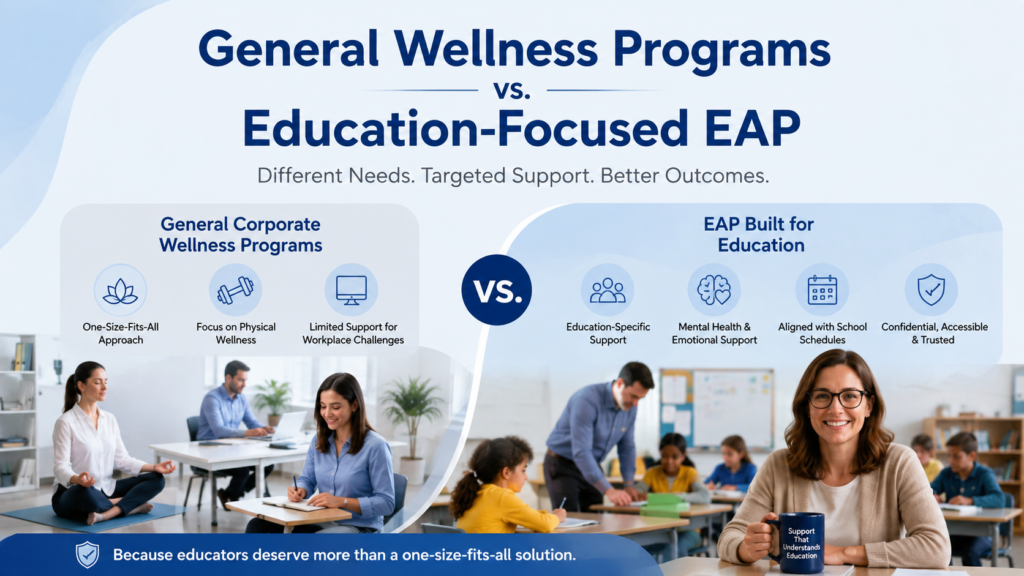
Many school districts already offer some version of corporate wellness programs — health screenings, discounted gym access, the occasional wellness webinar. These aren’t without value, but they rarely speak to the specific emotional demands of working in a classroom.
Most corporate wellness programs are built for environments where stress comes from deadlines and meetings. Teaching involves a different kind of pressure: managing dozens of personalities at once, absorbing student behavioral issues, and carrying the emotional residue of supporting children through difficult circumstances. A generic program, however well-intentioned, often misses this entirely.
This is why an EAP for education works best as a focused complement to broader corporate wellness programs rather than a substitute for them. It addresses the gaps that general wellness initiatives leave open, speaking directly to the realities of working in a school rather than assuming a standard office environment.
Core Components of an Effective EAP for Education
A strong EAP for education tends to include several essential pieces.
- Confidential counseling sits at the center. Teachers need a private space to talk through stress, anxiety, or burnout without worrying that it will affect how colleagues or administrators see them. That confidentiality is what makes staff willing to actually use the service.
- Flexible scheduling matters just as much. Counseling sessions need to fit around lesson planning, grading, and after-school commitments, not compete with them.
- Crisis support should be available year-round, including summer breaks, since stress and personal challenges don’t pause when the school year ends.
- Manager and administrator training rounds out the picture. School leaders should know how to recognize signs of burnout in their staff and how to point them toward help in a way that feels supportive rather than punitive.
Bringing these elements together, an EAP for education becomes more than a line item in a benefits package — it becomes a genuine support system for the people running the classroom every day.
The Case for Investing in an EAP for Education
Some school leaders still view an EAP for education as an added expense rather than a worthwhile investment. The numbers suggest otherwise. Burnout is strongly correlated with depression and anxiety, and untreated stress doesn’t stay contained to an individual teacher’s personal life — it shows up in absenteeism, lower classroom engagement, and eventually attrition.
Replacing a teacher is expensive. Recruiting, onboarding, and training a new hire takes significant time and resources, all while students experience the disruption of losing a familiar teacher mid-year or between terms. An EAP for education is a proactive way to provide support before stress and personal challenges become more difficult to manage. When combined with broader efforts to improve working conditions, workload, and workplace culture, an EAP may also support staff wellbeing and workforce stability.
In a tight labor market for educators, an EAP for education can also help with recruitment. Prospective teachers increasingly weigh wellbeing support alongside salary when choosing where to work, and a district that visibly invests in staff mental health stands out from one that doesn’t.
Implementing an EAP for Education: Where to Start
Rolling out an EAP for education doesn’t need to be complicated. Begin with an anonymous survey to understand what staff is actually struggling with — workload, student behavior, administrative burden, or something else entirely.
From there, choose a provider with genuine experience in education settings, rather than a generic vendor unfamiliar with the realities of a school calendar. Look for flexible hours, summer availability, and counselors who understand the specific stress of classroom work.
Clear communication is essential. Many teachers won’t use a program they don’t fully understand or trust, so introduce the EAP for education through staff meetings, written materials, and direct encouragement from school leadership. Make it explicit that using the service is confidential and has no bearing on job evaluations or contract renewal.
Finally, track usage trends, not individual cases, to see how the program is performing, and adjust based on what staff feedback reveals over time.
Conclusion
Teaching is meaningful work, but it’s also exhausting in ways that often go unspoken. The data is clear: educators are experiencing burnout, stress, and mental health challenges at rates that should concern every school administrator. Treating this as a personal problem for teachers to manage on their own only accelerates turnover and weakens the learning environment for students.
An EAP for education offers a practical, achievable response. It supports teacher mental health, strengthens education employee wellness, and helps build lasting workplace wellbeing in education rather than a once-a-year initiative. Combined with thoughtfully adapted employee wellness programs and corporate wellness programs, it creates a school environment where staff feel genuinely supported, not just expected to push through.
Schools that invest in this kind of support protect more than their staff. They protect the consistency, quality, and stability of the education their students receive. The time to build that support is now.
Frequently Asked Questions
An EAP for education can support staff retention by giving employees access to counseling, guidance, and other forms of support when they need them. Its impact on retention will vary, however, and EAPs work best alongside broader efforts to address workload, working conditions, and workplace culture.
Standard corporate wellness programs assume office schedules. An EAP for education adapts to academic calendars, summer breaks, and the emotional realities specific to classroom teaching.
EAP services are generally designed to provide confidential support, with personal information handled according to the provider’s privacy policies, applicable laws, and the terms of the program. Schools may receive aggregated or de-identified usage information, but reporting arrangements can vary by provider and program.