

Financial stress is one of the most significant yet often overlooked challenges affecting today’s workforce. It influences far more than an employee’s personal finances, impacting concentration, decision-making, productivity, and overall wellbeing throughout the workday. As the cost of living rises and financial uncertainty becomes more common, organizations are increasingly recognizing that employee financial wellbeing is not just a personal matter but a critical business priority.
The consequences for employers can be substantial. Financial concerns are widely recognized as a significant source of employee stress and may affect concentration, workplace engagement, and overall wellbeing. Financial stress can also contribute to absenteeism and presenteeism, creating productivity challenges for organizations. Yet despite its potential workplace impact, many employees still lack access to structured financial support through their workplace benefits.
An Employee Assistance Program (EAP) for financial wellness and counseling addresses this gap by providing employees with confidential access to professional financial counseling, personalized guidance, budgeting assistance, debt management support, and financial education. Integrated within a broader employee wellbeing strategy, an EAP helps employees improve their financial confidence while enabling organizations to foster greater productivity, resilience, and long-term workforce stability.
This article explores why an EAP for financial wellness and counseling has become an essential workplace benefit, the key components of an effective program, and practical considerations for organizations looking to implement one successfully.
Understanding the Employee Assistance Program
An employee assistance program, commonly referred to as an EAP, is a confidential workplace benefit that connects employees with professional support services. Historically, these programs have centered on mental health counseling, substance use support, and crisis intervention. Employers are increasingly recognizing that financial stress warrants equally structured attention.
An EAP for financial wellness and counseling extends this established model into the domain of personal finance. It provides employees with confidential access to qualified financial counselors who can assist with budgeting, debt management, savings strategies, and significant financial decisions, applying the same principles of professional, confidential support that govern traditional EAP services. The underlying rationale is straightforward: financial stress functions as a chronic stressor, affecting sleep, concentration, and overall wellbeing in ways comparable to other recognized workplace stressors. It therefore merits a dedicated, professional response rather than incidental guidance.
The Growing Importance of Employee Financial Wellbeing
Employee financial wellbeing has become a significant determinant of workforce engagement. Recent research indicates that a majority of employees report active financial stress, with many noting that their primary challenge is managing month-to-month expenses rather than long-term financial planning. A substantial proportion of employees maintain minimal emergency savings, leaving little capacity to absorb unexpected costs.
The consequences extend directly into organizational performance. The majority of financially stressed employees report symptoms of exhaustion and burnout, and a meaningful share indicate that financial concerns have materially affected their mental health. Additional research confirms that financial stress measurably reduces both productivity and motivation among affected employees. Employee financial wellbeing is therefore not a peripheral concern; it bears directly on performance, retention, and organizational morale, and warrants deliberate, sustained attention from employers.
Constructing a Comprehensive Financial Wellness Program
A meaningful financial wellness program extends well beyond distributing budgeting tools or general educational content. An effective financial wellness program delivers structured, ongoing support, encompassing individualized counseling, debt management guidance, emergency savings strategies, and financial education calibrated to each employee’s circumstances.
The most successful financial wellness program designs account for the considerable variation in financial circumstances across a workforce. Early-career employees may be managing student loan obligations, while mid-career employees often balance childcare expenses with long-term financial planning. Younger employees, in particular, report disproportionate effects of financial stress on their mental health and productivity. A uniform, undifferentiated financial wellness program is unlikely to serve such a varied workforce effectively.
An EAP for financial wellness and counseling addresses this challenge by combining structured financial education with confidential, individualized counseling, ensuring each employee receives guidance suited to their particular situation rather than generalized recommendations.
The Function of Financial Counseling for Employees
Financial counseling for employees represents the component of the program that translates general information into actionable guidance. While educational materials and webinars have value, they rarely achieve the impact of a direct consultation with a qualified counselor. Financial counseling for employees provides a confidential setting in which individuals can address debt, plan major purchases, or clarify complex financial circumstances without concern for judgment or disclosure.
This form of support is particularly significant because financial difficulties are often accompanied by a degree of personal discomfort, and employees frequently decline to raise these matters with managers or human resources directly. Delivering financial counseling for employees through a confidential EAP channel removes this barrier, affording staff the same discretion in seeking financial guidance that they would expect when addressing a medical or psychological concern.
Why Workplace Financial Wellness Extends Beyond the Individual
Workplace financial wellness carries implications that extend well beyond any single employee. It influences team performance, organizational culture, and ultimately financial outcomes for the business. A substantial majority of human resources professionals report that financially stressed employees demonstrate diminished performance, and most acknowledge that financial stress measurably affects morale and mental health across their organizations. A meaningful proportion of HR professionals also associate financial stress with unexcused absences and increased lateness.
These effects compound across teams, often manifesting as reduced collaboration and diminished trust, even where the underlying cause remains unaddressed. Prioritizing workplace financial wellness through a structured EAP for financial wellness and counseling can help organizations provide support for financial stress before its effects become more difficult to manage. It should form part of a broader approach to employee wellbeing rather than being viewed as a stand-alone solution to absenteeism, disengagement, or turnover.
Employer response to this challenge has accelerated. A clear majority of employers introduced some form of financial wellness initiative in recent years, marking a notable increase from prior periods. This trend reflects the transition of workplace financial wellness from an optional benefit to an expected element of a competitive compensation and benefits package.
The Evolution of Employee Wellness Programs
Employee wellness programs have traditionally emphasized physical and mental health, encompassing fitness benefits, counseling services, and general wellbeing initiatives. Financial wellbeing was frequently treated as a secondary or optional consideration. This approach is changing.
Contemporary employee wellness programs increasingly recognize the interconnection between financial stress and broader health outcomes. Financial stress activates a chronic physiological stress response, with documented implications for cardiovascular health, immune function, sleep quality, and mental health. Treating financial wellbeing as a separate, disconnected concern overlooks this established relationship.
An EAP for financial wellness and counseling represents a proactive way to support employees during periods of financial difficulty. When combined with broader employee wellbeing initiatives and supportive workplace practices, financial guidance may help employees manage financial concerns more effectively and support overall workforce wellbeing. Outcomes will vary depending on employee needs, program design, and how consistently the available support is used.
Essential Components of an Effective Program
An effective EAP for financial wellness and counseling typically incorporates several core elements.
Confidential individual counseling forms the foundation, providing employees a private setting in which to address debt, budgeting, or significant financial decisions independent of employer involvement.
Structured educational resources, including workshops and practical tools covering emergency savings, retirement planning, and debt reduction, should be tailored to varying career stages and financial circumstances.
Crisis support must be available for urgent situations, such as sudden job loss within a household or unexpected medical expenses requiring immediate financial guidance.
Manager awareness training completes the framework, equipping supervisors to recognize indicators of financial stress among their teams and direct employees toward appropriate support without overstepping professional boundaries.
Collectively, these components establish an EAP for financial wellness and counseling as a substantive organizational resource rather than a benefit that goes underutilized.
The Business Rationale for Investment
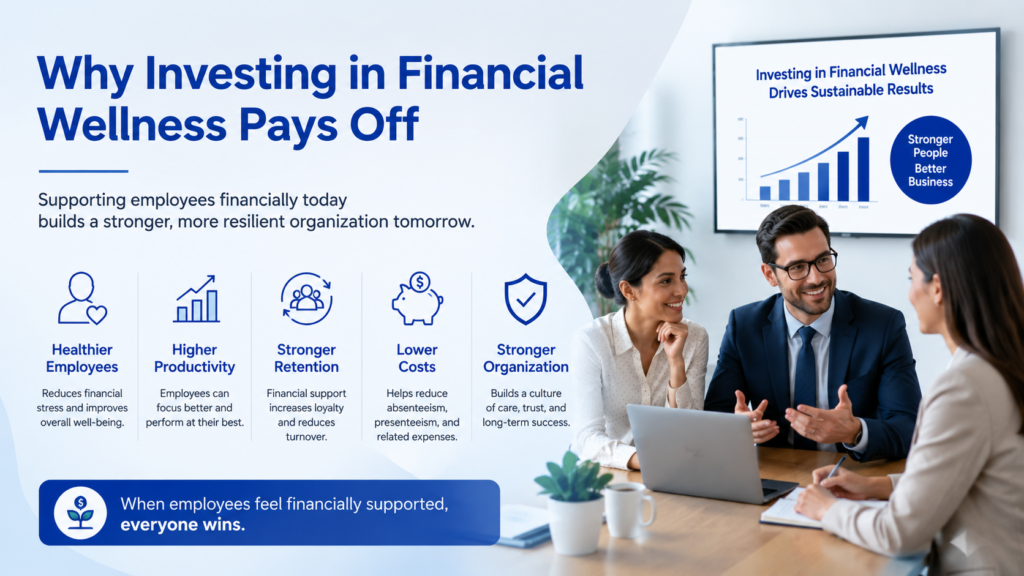
Some organizations continue to regard financial wellness benefits as a discretionary perk rather than a strategic investment. The available evidence suggests otherwise. Employer concern regarding employee financial well-being has risen steadily, with a growing proportion of organizations now rating this concern as a top priority. This trend reflects a tangible business risk: distracted and financially stressed employees impose real costs through reduced productivity, absenteeism, and elevated turnover.
An EAP for financial wellness and counseling represents a proactive way to support employees during periods of financial difficulty. When combined with broader employee wellbeing initiatives and supportive workplace practices, financial guidance may help employees manage financial concerns more effectively and support overall workforce wellbeing. Outcomes will vary depending on employee needs, program design, and how consistently the available support is used.
Implementing an EAP for Financial Wellness and Counseling
Implementing an EAP for financial wellness and counseling need not be a complex undertaking. Organizations should begin with an anonymous employee survey to identify specific areas of financial concern, whether debt, savings, retirement planning, or routine budgeting.
Subsequently, organizations should select a provider with genuine expertise in financial counseling, rather than a general wellness vendor offering financial content as a secondary service. Priority should be given to providers offering confidential individual access, flexible scheduling, and resources reflective of the organization’s diverse workforce.
Clear, judgment-free communication is critical to program success. Employees are unlikely to engage with a benefit they do not fully trust, making it essential to introduce the program through direct, empathetic messaging rather than dense policy documentation. Employers should clearly explain how confidentiality works, including how personal information is handled under the provider’s privacy policies, applicable laws, and the terms of the program. Participation in financial counseling should not be used as a factor in performance evaluation or employment decisions.
Finally, organizations should monitor aggregate engagement trends, rather than individual cases, to assess program effectiveness and refine offerings based on employee feedback over time.
Conclusion
Financial stress does not always remain isolated to an employee’s personal circumstances. It can affect concentration, workplace relationships, and overall engagement, with the impact varying depending on the individual and their circumstances. The evidence indicates that this is a widespread and costly organizational challenge, not an isolated concern affecting a limited subset of employees.
An EAP for financial wellness and counseling offers a structured, practical response to this challenge. It strengthens employee financial wellbeing, delivers meaningful financial counseling for employees, and establishes workplace financial wellness as a core element of organizational health. Integrated within a broader framework of employee wellness programs, it provides employees with substantive, individualized support rather than generalized guidance disconnected from their actual circumstances.
Organizations that invest in this form of support protect more than their financial performance. They protect the wellbeing of the people who sustain their operations. The action case is clear, and the time to act is now.
Frequently Asked Questions
It is a confidential workplace benefit providing employees with professional financial counseling, budgeting support, and debt guidance alongside traditional mental health and crisis services.
It integrates financial counseling within the same confidential framework as mental health support, reflecting the established connection between financial stress and emotional wellbeing.
EAP providers generally offer financial counseling as a confidential service. They handle personal information according to their privacy policies, applicable laws, and the terms of the program. Employers may receive aggregated or de-identified usage information, but reporting arrangements can vary by provider and program.