


There is a quiet irony at the center of most organizational wellbeing strategies. Companies invest in mental health resources for their workforce, train managers to recognize signs of distress in their teams, and build cultures that openly encourage employees to seek help when they need it. And then those same managers, the people expected to hold everyone else up, are left to manage their own pressure largely alone.
This is not a minor oversight. It is a structural gap with measurable consequences. A Microsoft survey of 20,000 workers across 11 countries found that 53 percent of managers reported burnout at work, while separate research indicates that over 52 percent of leaders experience burnout symptoms, with many considering leaving their roles entirely to protect their health. When employees feel well-supported by their manager, they are 4.5 times less likely to be looking for another job. The flip side of this is equally significant: a burned-out manager cannot provide that support, and the ripple effects move directly into team performance, retention, and morale.
An EAP for managers and leaders addresses this gap directly. It acknowledges that leadership is not a shield against personal struggle – it is, by many measures, a significant amplifier of it. This article explores why manager wellbeing and leadership mental health deserve their own dedicated support framework, and what an effective EAP for managers and leaders should look like in practice.
Why Leadership Can Be an Isolating Role
It is worth being honest about what the managerial role actually involves in most organizations. Managers are simultaneously responsible for their own performance and the performance of everyone reporting to them. They absorb pressure from senior leadership above and manage the needs, conflicts, and wellbeing of their teams below. Research from Perceptyx confirms that managers consistently score lower on work-life balance than both executives and individual contributors – sitting in the most exposed position in the entire organizational hierarchy.
Many managers are also part of the sandwich generation, caring for both children and aging parents. Research found that 78 percent of caregiving managers say it affects their focus at work, yet most are not trained to support others’ mental health, let alone their own. They are asked to model balance and catch burnout warning signs in their teams, often without any practical tools for doing so.
This is the reality that an EAP for managers and leaders must be designed around – not the idealized version of leadership, but the actual daily experience of people managing competing demands from every direction.
The Leadership Mental Health Problem Nobody Talks About
Leadership mental health can carry a particular stigma, as many leaders may worry that acknowledging personal difficulties could affect how others perceive their competence or authority. This concern can discourage some managers and leaders from seeking support. When leaders experience sustained stress or burnout, it may affect their wellbeing, decision-making, and ability to support others, making accessible and confidential professional support an important part of a broader workplace wellbeing strategy.
Toxic workplace behaviors increase burnout risk eightfold for executives and leaders, according to McKinsey research, while productivity losses amount to thousands of dollars per employee annually, with one trillion dollars lost globally due to stress-related issues. These figures are not abstract – they represent the compounding cost of leadership mental health going unaddressed at scale.
An EAP for managers and leaders that provides confidential, professional support without any implicit judgment about what seeking help means for one’s professional image is not a luxury. It is a foundational requirement for sustainable leadership.
Manager Wellbeing and Its Downstream Effects
Manager wellbeing can influence the wider team experience. Research has identified associations between supportive management, employee wellbeing, and lower levels of burnout. However, team wellbeing also depends on workload, staffing, workplace culture, and other organizational conditions. Supporting manager wellbeing through an EAP can therefore form part of a broader approach to creating healthier workplace environments.
Burnout can affect an employee’s wellbeing, attendance, confidence, and ability to perform at their usual capacity. When managers experience sustained burnout, the effects may also influence team communication and day-to-day leadership. An EAP for managers and leaders can provide confidential support during periods of stress, while organizations continue to address broader workplace factors that contribute to burnout.
What Executive Wellness Actually Requires
Executive wellness is frequently conflated with perks: leadership retreats, executive health screenings, premium gym memberships. These have their place, but they do not address the psychological and emotional dimensions of leadership stress in any sustained way. What senior leaders often need most is something considerably more straightforward: a confidential space to speak honestly about the pressures they are carrying, with a professional who understands organizational dynamics and has no stake in what they share.
Research in 2025 shows that 56 percent of leaders face burnout, impacting organizational stability and innovation. Effective executive wellness, as distinct from general wellness benefits, recognizes that leaders face a specific category of pressure – isolation at the top, the weight of high-stakes decisions, and the expectation of perpetual composure – that requires tailored support rather than a generic employee benefit applied without adaptation.
An EAP for managers and leaders can support workplace wellbeing by providing leadership teams with access to confidential professional support. When combined with broader organizational efforts, this support may help managers respond more effectively to the pressures of their roles. Team wellbeing and workplace culture, however, also depend on workload, staffing, organizational practices, and other structural conditions.
How Employee Wellness Programs Typically Miss the Leadership Layer
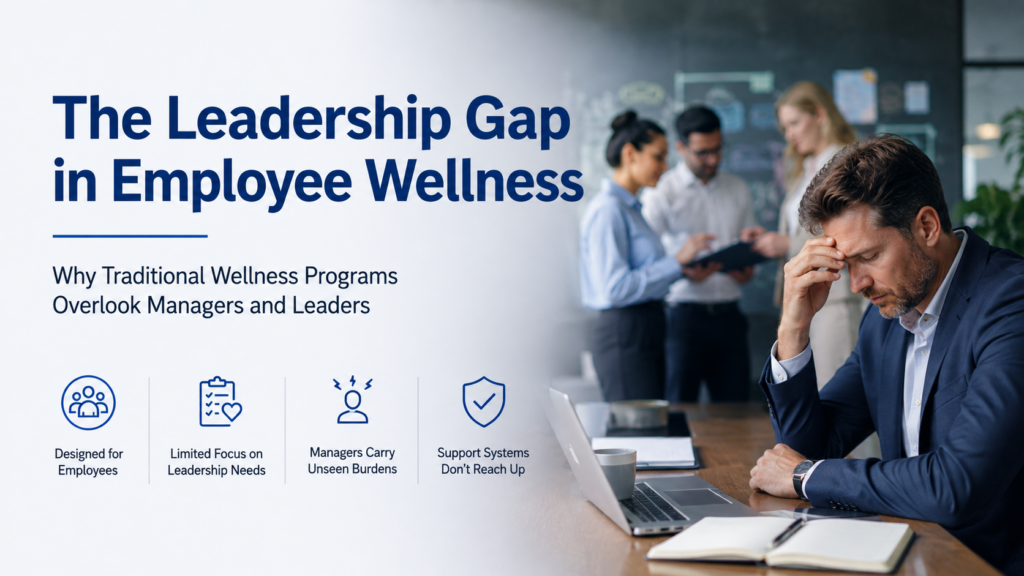
Most employee wellness programs focus on the general workforce and design their support resources, communication channels, and engagement strategies around the needs of individual contributors. Although these programs typically include managers and leaders, they often do not address their specific needs effectively.
Around 22 percent of managers report not knowing whether their workplace offers mental health benefits such as employee assistance programs or mental health days. This is a striking finding. If managers – the people responsible for communicating these resources to their teams – are unaware of what exists, the gap between policy and practice is significant.
Organizations should communicate employee wellness programs for managers and leaders directly and clearly, without suggesting that using them reflects inadequacy. They should also present these programs as professional resources rather than crisis interventions, encouraging leaders to seek support before reaching a breaking point.
Workplace Wellbeing Starts at the Top
The relationship between leadership behavior and broader workplace wellbeing is well established. Leaders who model healthy boundaries, openly acknowledge limits, and demonstrate that wellbeing is a genuine organizational value rather than a policy formality create conditions in which the entire workforce feels more supported. The opposite is equally true, and the effects are equally far-reaching.
An EAP for managers and leaders supports workplace wellbeing not only by addressing the individual needs of those in leadership roles, but by equipping those leaders to create healthier environments for everyone around them. When managers are well, teams are more likely to be well. When leadership is stable, organizational culture is more likely to reflect the values organizations aspire to rather than the pressures they are quietly failing to manage.
Core Components of an Effective EAP for Managers and Leaders
A well-designed EAP for managers and leaders differs from a general EAP in several meaningful ways.
Confidential counseling with practitioners who understand organizational and leadership dynamics is foundational. Managers need to feel that their counselor grasps the context of their role, not just general mental health principles.
Leadership-specific coaching support, integrated with or complementary to counseling, helps leaders build resilience strategies that are practically applicable to their day-to-day responsibilities rather than generically aspirational.
Peer support networks for managers – structured, confidential forums where leaders can share experiences with colleagues facing similar challenges – address the isolation that many in leadership roles experience but rarely name directly.
Crisis support available outside business hours matters as much for leaders as for any other employee, given that leadership stress rarely confines itself to the working day.
Clear, judgment-free communication about how to access the program is essential, given the specific stigma that surrounds help-seeking at senior levels.
Together, these components build an EAP for managers and leaders that functions as a genuine professional resource rather than a benefit that exists in theory but goes unused in practice.
The Organizational Case for Investment
Leadership turnover can involve significant recruitment, onboarding, transition, and institutional knowledge costs. An EAP for managers and leaders can provide confidential support during periods of stress or personal difficulty and form part of a broader strategy to support workforce wellbeing and stability. Its effect on burnout, retention, and other organizational outcomes will vary depending on workplace conditions, employee needs, program design, and the wider actions an organization takes to address sources of stress.
Sustained stress can affect a leader’s wellbeing, concentration, and ability to manage demanding responsibilities. Supporting leadership mental health can provide managers and senior leaders with resources to address personal and professional pressures. Organizations should view this support as one part of a broader approach to sustaining effective leadership and workplace wellbeing.
Conclusion
Leadership comes with genuine privilege, and it also comes with genuine pressure. The expectation that managers and senior leaders should simply absorb that pressure without adequate support is neither realistic nor sustainable, and the data increasingly confirms that it is not working.
An EAP for managers and leaders offers something straightforward and valuable: a confidential, professional space where those in leadership roles can seek support without judgment, access resources tailored to the specific demands of their position, and sustain the wellbeing necessary to lead effectively over time. It strengthens manager wellbeing, supports leadership mental health, and reinforces workplace wellbeing as an organizational reality rather than a stated aspiration.
The people responsible for holding organizations together deserve to be held up too. That support begins with recognizing their need for it, and investing in the structures that make it genuinely accessible.
Frequently Asked Questions
Managers face unique pressures, including responsibility for team wellbeing, organizational expectations of composure, and isolation at senior levels – demands a generic employee wellness program rarely addresses adequately.
EAP services are generally designed to provide confidential support. Providers handle personal information according to their privacy policies, applicable laws, and the terms of the program. Employers may receive aggregated or de-identified usage information, but confidentiality and reporting arrangements can vary by provider and program.
Supportive management has been associated with better employee wellbeing and lower levels of burnout. Supporting manager wellbeing can therefore form part of a broader workplace wellbeing strategy, alongside efforts to address workload, staffing, workplace culture, and other organizational factors.